
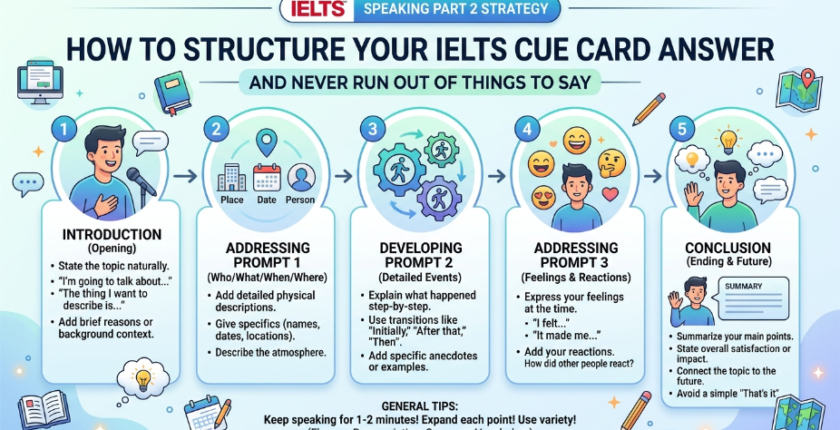
Forty seconds into your cue card answer, you’ve covered the who, what, and when. There’s still a minute and twenty seconds left, the examiner is watching, and your mind has gone completely blank. You start a sentence, trail off, say “um” a few too many times, and the silence starts to feel enormous even though it’s really just three or four seconds.
This is one of the most common ways candidates lose marks in Part 2, whether you’re testing in Lahore, Karachi, or anywhere else in Pakistan, and it usually has nothing to do with actual English ability. It’s a planning problem, not a language problem. Here’s exactly how to structure your thinking so you never run out of things to say before your two minutes are up.
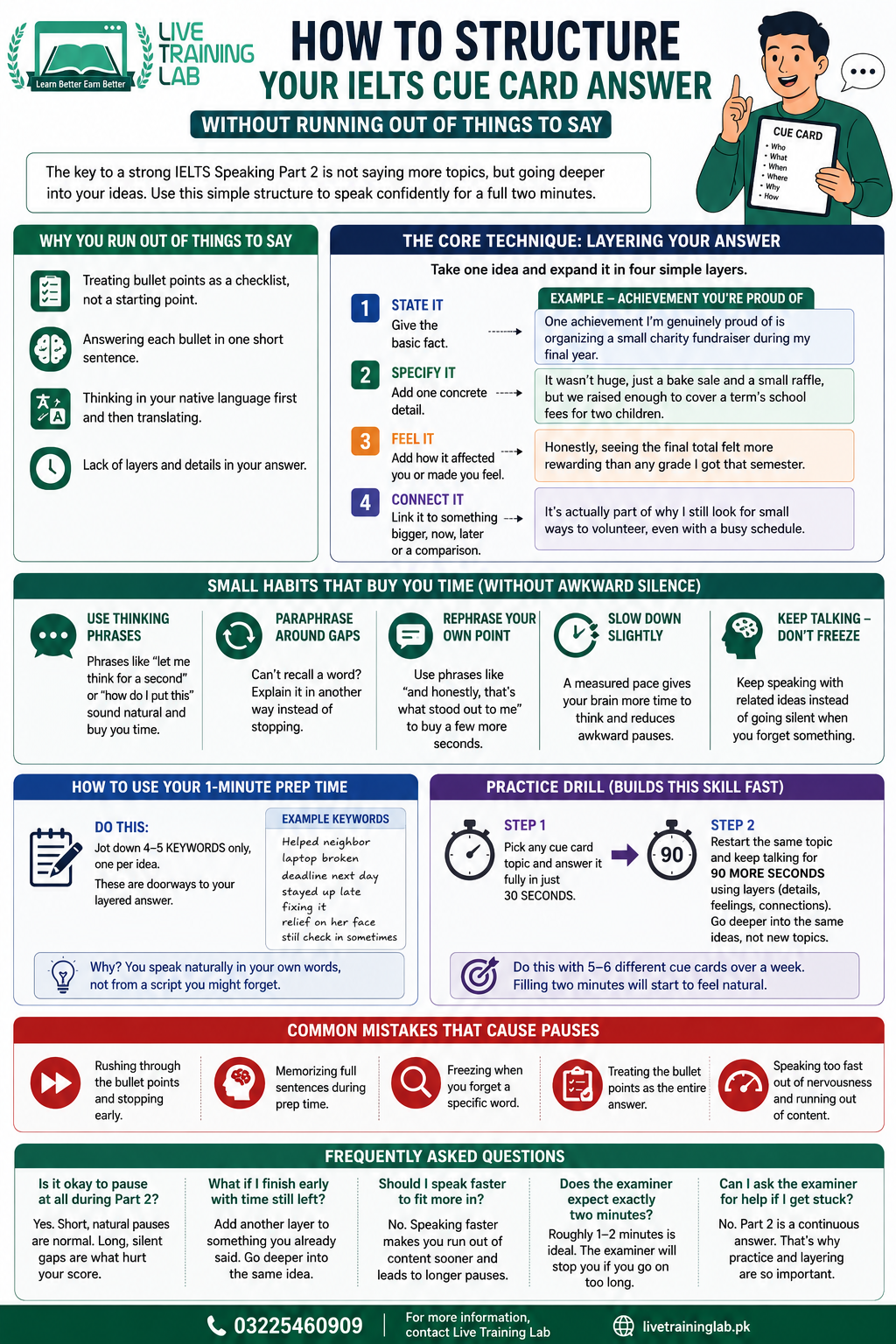
The Layering Method: Never Run Out of Things to Say
Many IELTS candidates run out of ideas because they treat the cue card as a checklist instead of expanding each point. A simple way to keep speaking confidently for the full two minutes is to use the Layering Method: first state your main idea, then add a specific detail, explain how you felt, and finally connect it to a lesson, comparison, or future experience. During your one-minute preparation time, write only a few keywords instead of full sentences, speak at a steady pace, use natural thinking phrases when needed, and paraphrase words you can’t remember. This approach helps improve fluency, reduces long pauses, and makes your answer sound more natural, organized, and engaging.

Why You Run Out of Things to Say
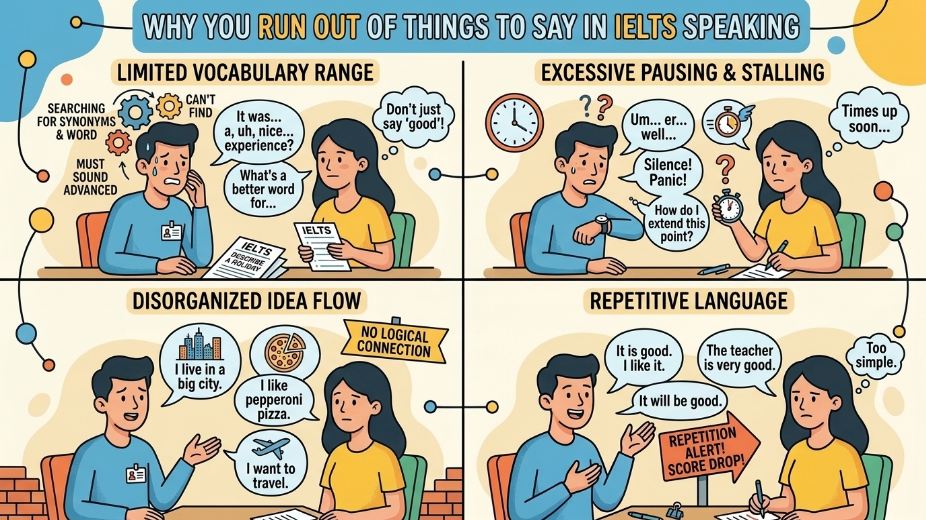
Most students prepare for Part 2 by mentally answering each bullet point on the card, one short sentence per bullet. “This is my teacher. I met her in college. She helped me improve. She inspired me.” That’s a complete, accurate answer, and it’s also over in about thirty seconds.
The problem is treating the bullet points as a checklist rather than a starting point. Once every box is ticked, there’s genuinely nothing left prepared, so the brain goes quiet mid-sentence while searching for something new to add on the spot.
There’s also a translation lag at play. If you’re mentally forming an idea in Urdu or Punjabi first and then converting it to English, that extra step costs you a second or two every single time, and those seconds add up into visible hesitation. The fix for both issues is the same: build more layers into your answer before you ever open your mouth, not just more accurate facts.
The Core Technique: Layering Your Answer
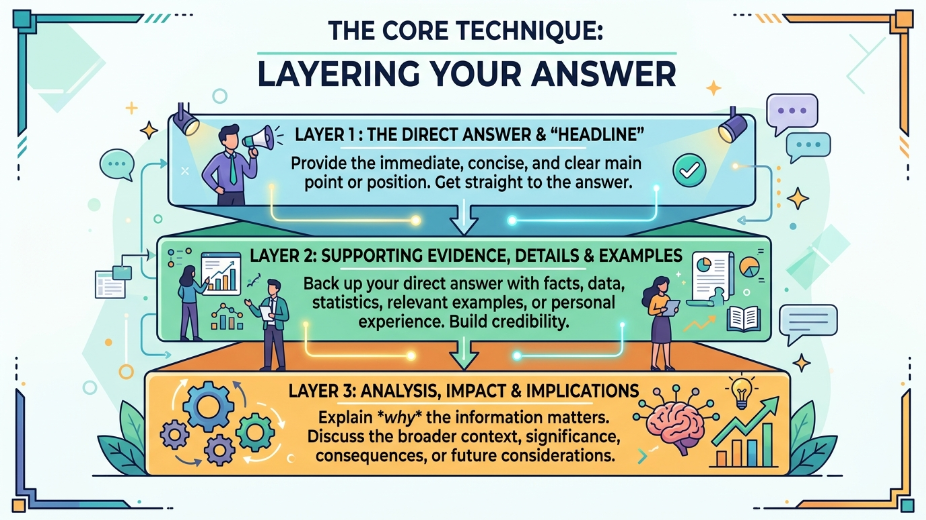
Instead of answering each bullet point once, answer it in layers. Every idea you mention can be expanded through four simple moves. Say your cue card is about an achievement you’re proud of, and your basic fact is: “I organized a small fundraiser at university.”
- State it. Give the basic fact. “One achievement I’m genuinely proud of is organizing a small charity fundraiser during my final year.”
- Specify it. Add one concrete detail. “It wasn’t huge, just a bake sale and a small raffle, but we raised enough to cover a term’s school fees for two children.”
- Feel it. Add how it affected you or made you feel. “Honestly, seeing the final total felt more rewarding than any grade I got that semester.”
- Connect it. Link it to something bigger, now, later, or a comparison. “It’s actually part of why I still look for small ways to volunteer, even with a busy schedule.”
Notice that’s four full sentences built from one single fact, stretched out naturally rather than padded with filler. Do this with just two or three ideas from your cue card, and two minutes stops feeling like a stretch. The layering technique works because it gives you somewhere to go the moment you finish a thought, instead of leaving you searching for an entirely new idea. You’re not inventing new content on the spot; you’re simply going one level deeper into something you already said.
Small Habits That Buy You Time Without Awkward Silence
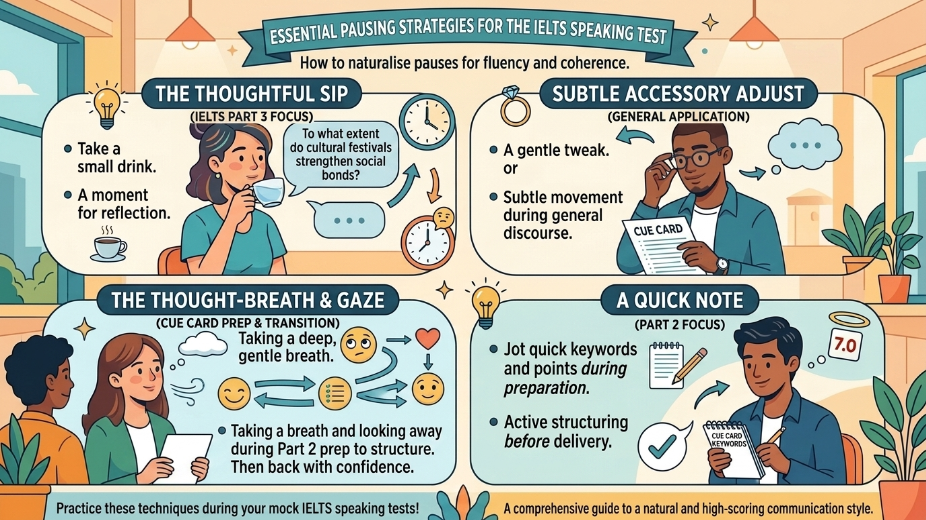
- Use natural thinking phrases instead of silence. Real, fluent speakers say things like “let me think for a second” or “how do I put this” all the time. These phrases sound completely natural and buy you a moment to organize your next sentence, which is very different from a dead, silent pause.
- Paraphrase around words you can’t recall. If you forget the word “microwave,” say “the thing you use to heat food up quickly” instead of stopping to search your memory. Examiners reward flexible communication, not perfect vocabulary recall.
- Rephrase your own point. Saying “and honestly, that’s really what stood out to me” while you think of your next sentence sounds like natural emphasis, not stalling, and buys you another second or two.
- Slow down slightly instead of rushing. Speaking a little slower gives your brain more processing time per sentence, which means fewer moments where your mouth catches up to your thoughts and then has nothing left to say.
How to Use Your 1-Minute Prep Time Properly
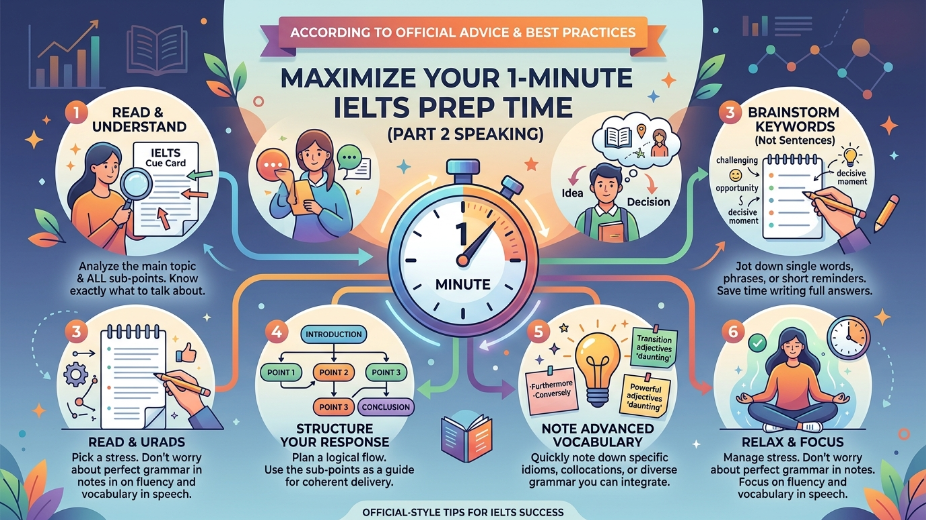
Most students waste their preparation minute writing full sentences, which backfires the moment memory fails under pressure. If you planned an exact sentence and forget the wording mid-answer, you pause while your brain searches for the “correct” phrasing instead of just saying something else.
Instead, jot down four or five keywords only, one per idea, not full sentences. For a cue card about a time you helped someone, that might look like: “Helped neighbor laptop broken, deadline next day stayed up late fixing it relief on her face still check in sometimes.” Each keyword is a doorway into a layered answer you build live, in your own natural phrasing, rather than a script you’re trying to recall word for word.
This also protects you if your mind blanks on one word, since you’re speaking from memory of an idea, not memory of exact vocabulary.
A Practice Drill That Builds This Skill Fast
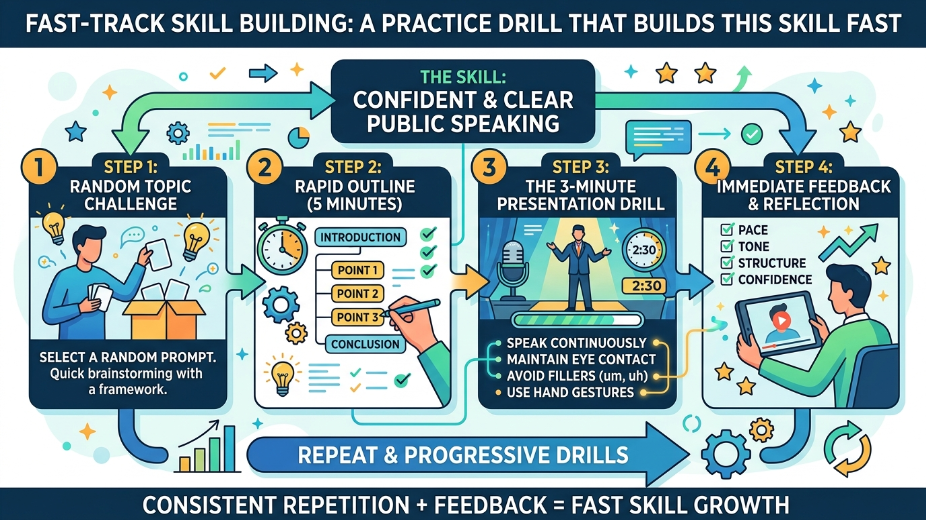
Try this specific drill at home: pick any cue card topic, set a timer, and answer it fully in just thirty seconds. Stop completely when the thirty seconds end.
Now restart the same topic, but this time your only rule is to keep talking about it for a full ninety more seconds, using the layering technique, specifics, feelings, and connections, on the same one or two ideas you already mentioned. Don’t introduce a completely new topic; go deeper into what you already said.
Repeat this with five or six different cue cards over a week, whether you’re prepping in Islamabad, Rawalpindi, or Faisalabad, and filling two minutes on any topic starts to feel like default behavior rather than something you have to force. It trains the specific muscle of extending an idea, which is exactly what real exam pressure tests.
Common Mistakes That Cause Pauses
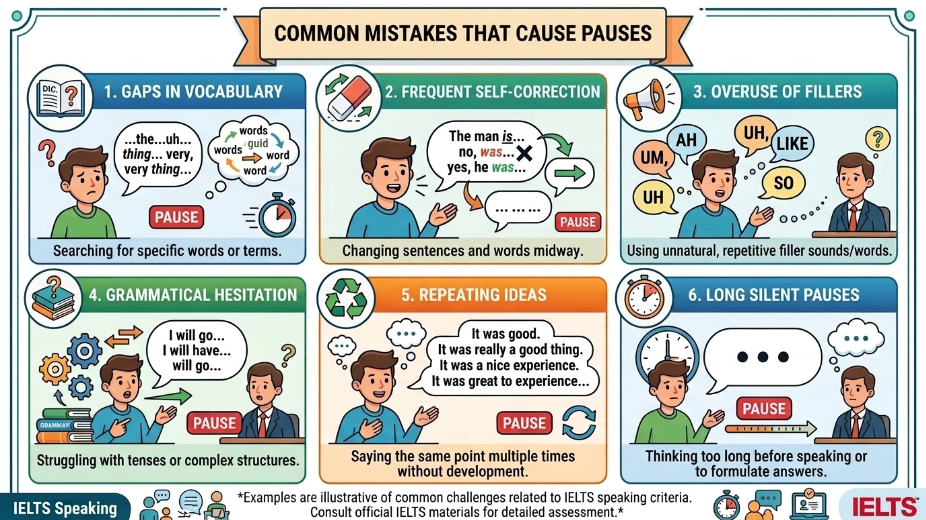
- Rushing through the bullet points and stopping. Finishing in under a minute leaves an uncomfortable silence that hurts your fluency score more than a slightly slower, fuller answer would.
- Memorizing full sentences during prep time. The moment your memory fails mid-sentence, you pause to recall exact wording instead of simply saying the idea differently.
- Freezing when you forget a specific word. Stopping to search your memory costs far more time and marks than paraphrasing around the gap would.
- Treating the bullet points as the entire answer. They’re a starting skeleton, not the finished structure. The extra marks come from what you add beyond them.
- Speaking too fast out of nervousness. This often causes you to run out of prepared content early, right into a long, visible pause with time still left on the clock.
Frequently Asked Questions
Is it okay to pause at all during Part 2?
Short, natural pauses for thinking are completely normal and expected, even in high-scoring answers. What hurts your score is a long, silent gap where you visibly don’t know what to say next, not a brief moment of thought.
What if I genuinely finish early, with time still left?
Add another layer to something you already said rather than panicking. Go back to a detail, explain why it mattered, or compare it to something else, instead of trying to invent a brand new point from nothing.
Should I speak faster to fit more into two minutes?
No. Speaking faster usually means running out of prepared content sooner, which leads to a longer pause, not a shorter one. A measured pace with layered content works better than rushed, thin content.
Does the examiner expect exactly two minutes?
Roughly one to two minutes is the expected range. The examiner will stop you if you go on too long, so filling close to the full two minutes, without stretching painfully, is a good target.
Can I ask the examiner for help if I get stuck?
No, Part 2 is meant to be a continuous, uninterrupted answer. This is exactly why building layering and paraphrasing habits before test day matters so much.
Talking for two minutes without pausing isn’t about having more to say than everyone else. It’s about knowing how to go deeper into the same two or three ideas instead of racing through a checklist and running dry. Practice the layering technique, plan with keywords instead of full sentences, and fill natural gaps with thinking phrases instead of silence, and the two-minute mark stops feeling like a wall you might hit.
If you’d like guided speaking practice with real feedback on your pacing and fluency, Live Training Lab’s Spoken English course is built around exactly this kind of hands-on practice you can see what’s available at livetraininglab.pk.