
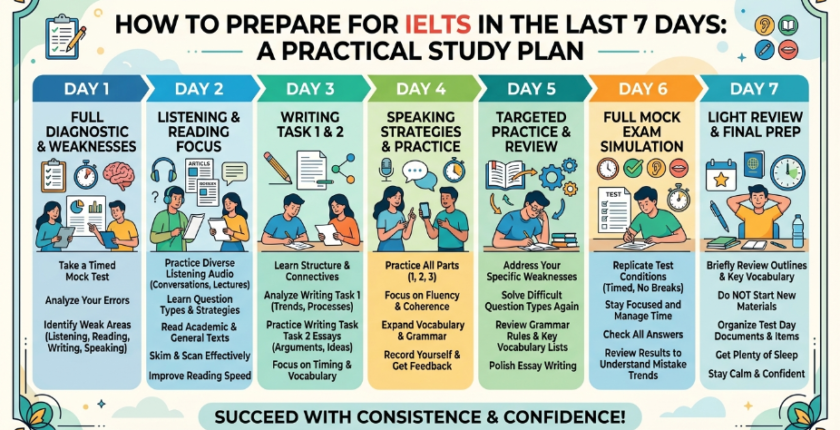
How to Prepare for IELTS in the Last 7 Days: A Practical Study Plan
You’ve got a week left before your IELTS test, and that mix of panic and denial is setting in. Maybe the exam snuck up on you, maybe you kept pushing prep to “next week” until there wasn’t a next week left. Either way, you’re here now, and the good news is that seven focused days can genuinely move your score, just not in the way most people assume.
A week isn’t enough time to learn English from scratch, and nothing here promises that. What is enough time for is fixing the specific, fixable mistakes that quietly cost candidates a full band score: poor time management, format confusion, weak exam technique, and simple carelessness under pressure. Here’s exactly how to spend the seven days you have left.
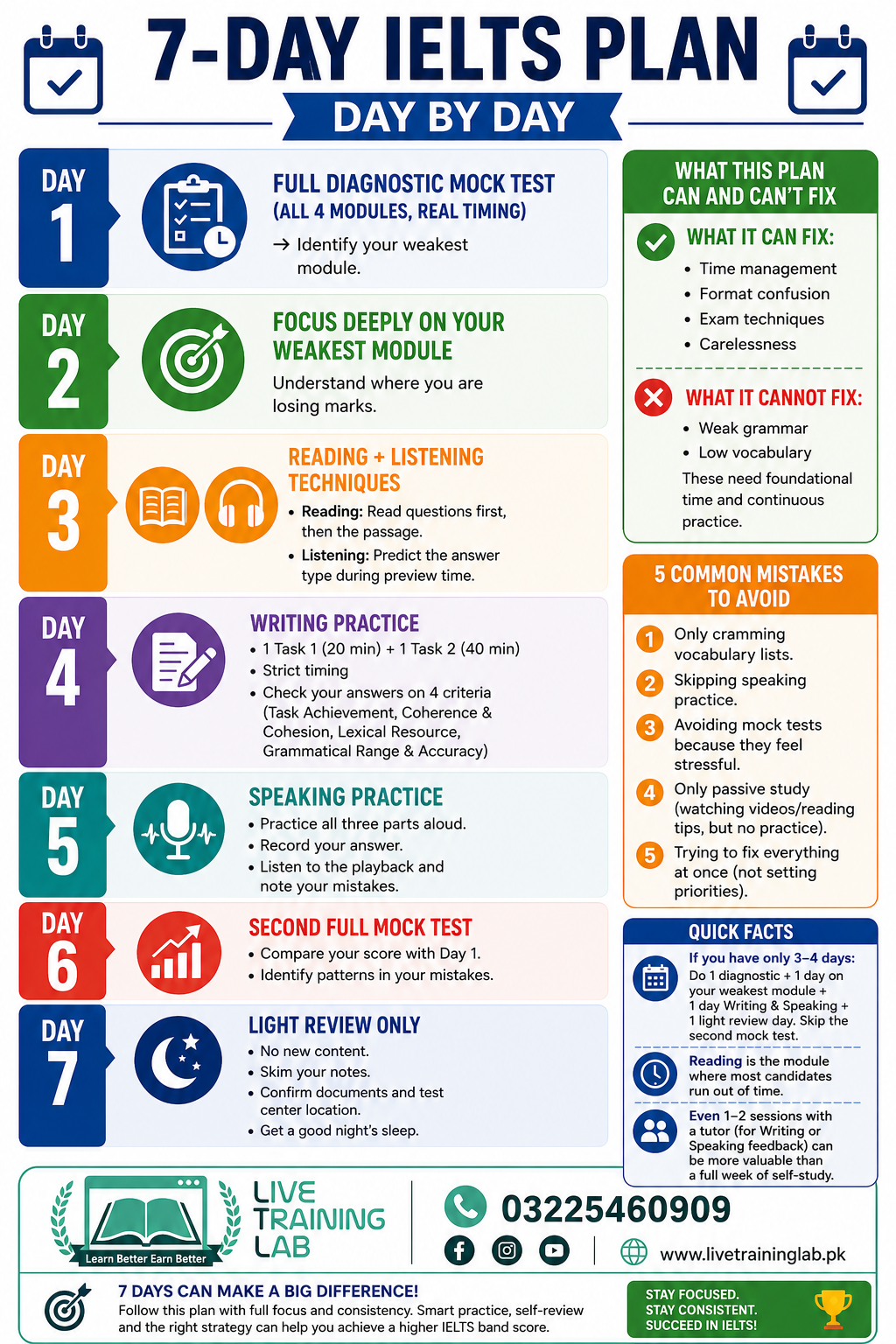
7 Days Can Improve Your Score, If You Practice Smart
Agar aap sirf 7 din mein apni IELTS preparation ko organize karna chahte hain, to ye plan aapko exam strategy, time management aur common mistakes se bachne mein help karega. Roz sirf focused practice, mock tests aur self-review par kaam karein. Consistency aur smart preparation hi better IELTS band score ki key hai.

Is a 7-Day Plan Actually Realistic?
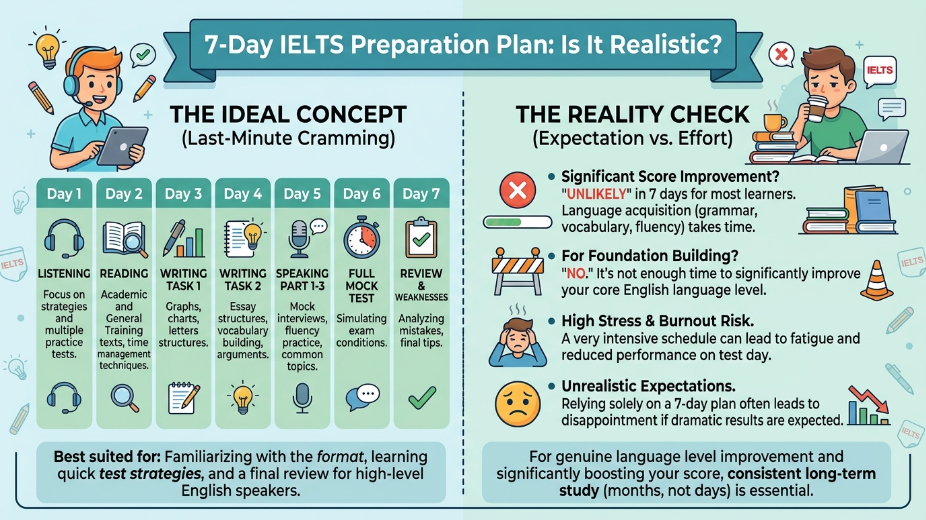
Let’s be honest about what this week can and can’t do. It won’t turn weak grammar into strong grammar, and it won’t build a large vocabulary overnight. If your English level genuinely needs more foundational work, a week of intense cramming isn’t a substitute for that.
What it can do is stop you from losing marks you’ve technically already earned. Plenty of candidates understand the material but lose points to running out of time in Reading, writing more words than the limit allows in Listening, or freezing up during a cue card because they never practiced speaking under pressure. Those are technique problems, not English problems, and technique is exactly what a focused week can fix.
Your 7-Day IELTS Study Plan
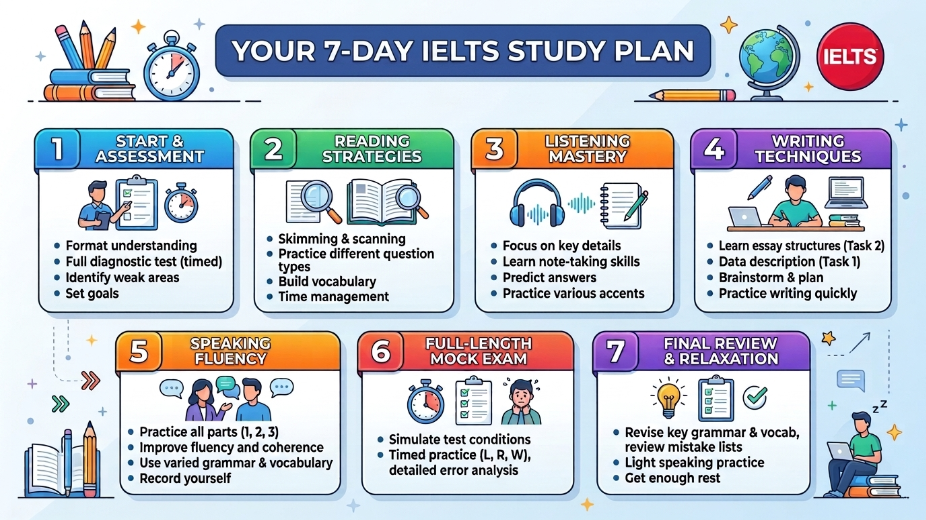
Here’s how to structure the week so each day builds on what you learned the day before.
Day 1: Take a Full Diagnostic Test
Before you study anything, find out where you actually stand. Take one complete mock test, all four modules, under real timing conditions, no pausing, no looking things up.
Don’t review your answers in detail yet. The point of Day 1 is to see your rough band score per module and notice which one clearly lags behind the others. That module becomes your priority for the rest of the week, rather than spreading your limited time evenly across all four.
Day 2: Deep-Dive Your Weakest Module
Spend today entirely on whichever module scored lowest on your diagnostic. If it’s Reading, practice skimming for main ideas before scanning for specific answers. If it’s listening, focus on staying calm after a missed question instead of chasing it. If it’s writing, review the actual band descriptors so you know exactly what’s being scored. If it’s speaking, record yourself answering a cue card and listen back.
Whatever the module, the goal today isn’t a broad review; it’s understanding precisely why you’re losing marks there.
Day 3: Reading and Listening Technique
Today is about exam strategy more than content. For Reading, practice reading the questions before the passage, so you know what to scan for. Time yourself strictly, since Reading is the module where candidates most often run out of time.
For listening, practice using the preview time before each section to predict answer types, a name, a number, a place, before the recording starts. Do at least one section of each under timed conditions, then check exactly which mistakes cost you marks: careless spelling, missed word limits, or lost focus after one wrong answer.
Day 4: Writing Practice
Write one full Task 1 and one full Task 2 response today, under strict 20 and 40-minute limits. Resist the urge to look up “impressive” vocabulary mid-task; focus on finishing within time with a clear structure instead.
Afterward, check your work against the four writing criteria: did you address the full question, organize your paragraphs logically, use accurate and varied vocabulary, and control your grammar well? If you can get a teacher or tutor to look at it, even better, since self-review often misses your own blind spots.
Day 5: Speaking Practice
Practice all three parts of the Speaking test today, out loud, ideally with another person or at least recorded on your phone. Part 1 questions should feel conversational, Part 2 needs you to fill close to two minutes without memorizing a script, and Part 3 pushes you to explain opinions, not just describe things.
Listen back to your recording and note where you paused too long, repeated the same basic vocabulary, or lost the thread of your answer. These are the exact habits worth correcting in your final two days.
Day 6: Second Full Mock Test
Take a second complete mock test under real exam conditions, ideally at the same time of day as your actual test. Compare this result to your Day 1 diagnostic; you should see clear improvement in your previously weakest module.
Spend the rest of the day reviewing exactly which questions you got wrong and why, not just what the correct answer was. If the same type of mistake shows up more than once, that’s the one habit worth fixing tomorrow morning before you stop studying altogether.
Day 7: Light Review and Rest
This is not a day for new content or another mock test. Skim your notes on common mistakes, confirm your test center location and required documents, and lay out what you need for the morning.
Cramming the night before rarely helps and often backfires, since exhaustion affects your concentration far more than one extra hour of review does. Get proper sleep instead. A well-rested brain that’s seen the format seven times performs better than a tired one that crammed vocabulary until midnight.
Common Mistakes to Avoid During Last-Minute Prep
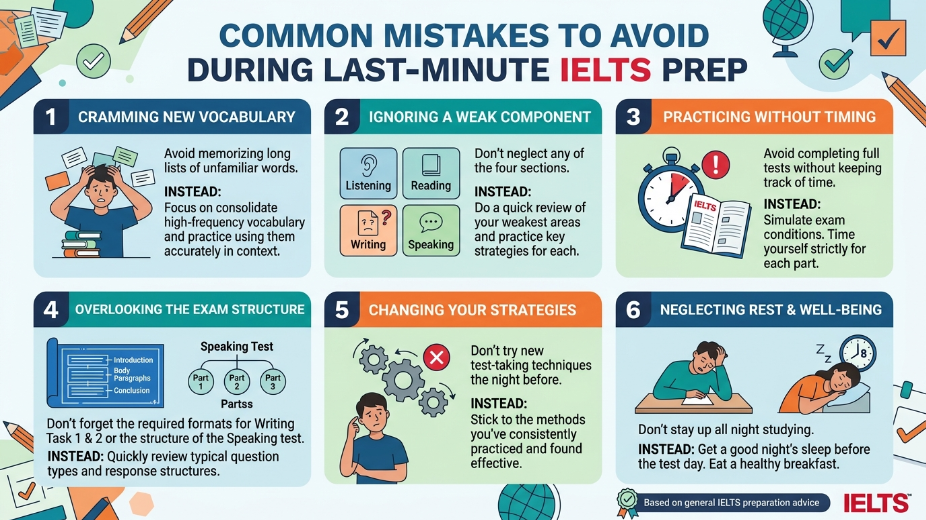
- Cramming vocabulary lists instead of practicing the technique: A long list of advanced words rarely shows up usefully in the exam, while fixable habits like time management genuinely do.
- Skipping Speaking practice because it feels less urgent: Many students focus entirely on Reading and Writing during a short prep window and walk into speaking having barely rehearsed out loud all week.
- Avoiding mock tests because they’re stressful: A mock test under real timing is one of the most useful things you can do with limited time, even when the score feels discouraging.
- Studying passively: Reading tips and watching videos feel productive, but they don’t build the muscle memory that timed practice does.
- Panicking instead of prioritizing: With one week left, trying to fix everything at once usually means fixing nothing properly. Pick your weakest area and commit to it.
Frequently Asked Questions
Can I actually improve my band score in just seven days?
You can meaningfully reduce the marks you lose to technique and carelessness, which for many candidates adds up to more than expected. What a week can’t do is replace months of language learning if your English level genuinely needs more time.
What if I only have three or four days, not seven?
Compress the plan: one diagnostic test, one day on your weakest module, one day covering Writing and Speaking together, and a final light review day. Skip the second mock test if time is truly limited.
Should I study every module equally during a short prep window?
No. Spend more time on whichever module is weakest, since that’s where the biggest score gains usually come from in a limited timeframe.
Is it worth hiring a tutor for just one week?
If you can get even one or two sessions of honest, specific feedback on your Writing or Speaking, it’s often worth more than several days of unguided self-study, simply because you can’t always spot your own patterns.
Should I take the test if I don’t feel ready after a week?
That depends on your deadline. If postponing is possible and your goal score is far off, waiting and preparing properly is usually the better option. If the date is fixed, focus this week on damage control rather than perfection.
A 7-day IELTS study plan isn’t about cramming everything you should have learned months ago. It’s about spending a short window wisely: finding out where you actually stand, fixing the technique mistakes that quietly cost marks, and walking in familiar with the format instead of anxious about it. Students preparing in Rawalpindi, Multan, or anywhere else in Pakistan face the same time crunch, and the same structured approach works regardless of where you’re testing.
If you’d like structured, guided practice instead of figuring this out alone under pressure, Live Training Lab’s Spoken English course can help you build the fundamentals faster — you can see what’s available at livetraininglab.pk.