

Why Your IELTS Score Decides Your Express Entry Future
So you’ve decided Canada is the plan. You’ve probably checked your NOC code, maybe even guessed at your CRS score late one night, and now there’s one number standing between you and an Invitation to Apply: your IELTS band score.
Here’s what most guides won’t tell you upfront Canada doesn’t actually look at your IELTS band score directly. It converts your score into something called a Canadian Language Benchmark (CLB), and that CLB number is what decides both your eligibility for Express Entry and how many Comprehensive Ranking System (CRS) points you walk away with. Get this part wrong, and you can miss the pool entirely, even with a score that looks “good” on paper.
Let’s break down exactly what you need, section by section, so there’s no guesswork left.

Understand Your IELTS Score for Canada
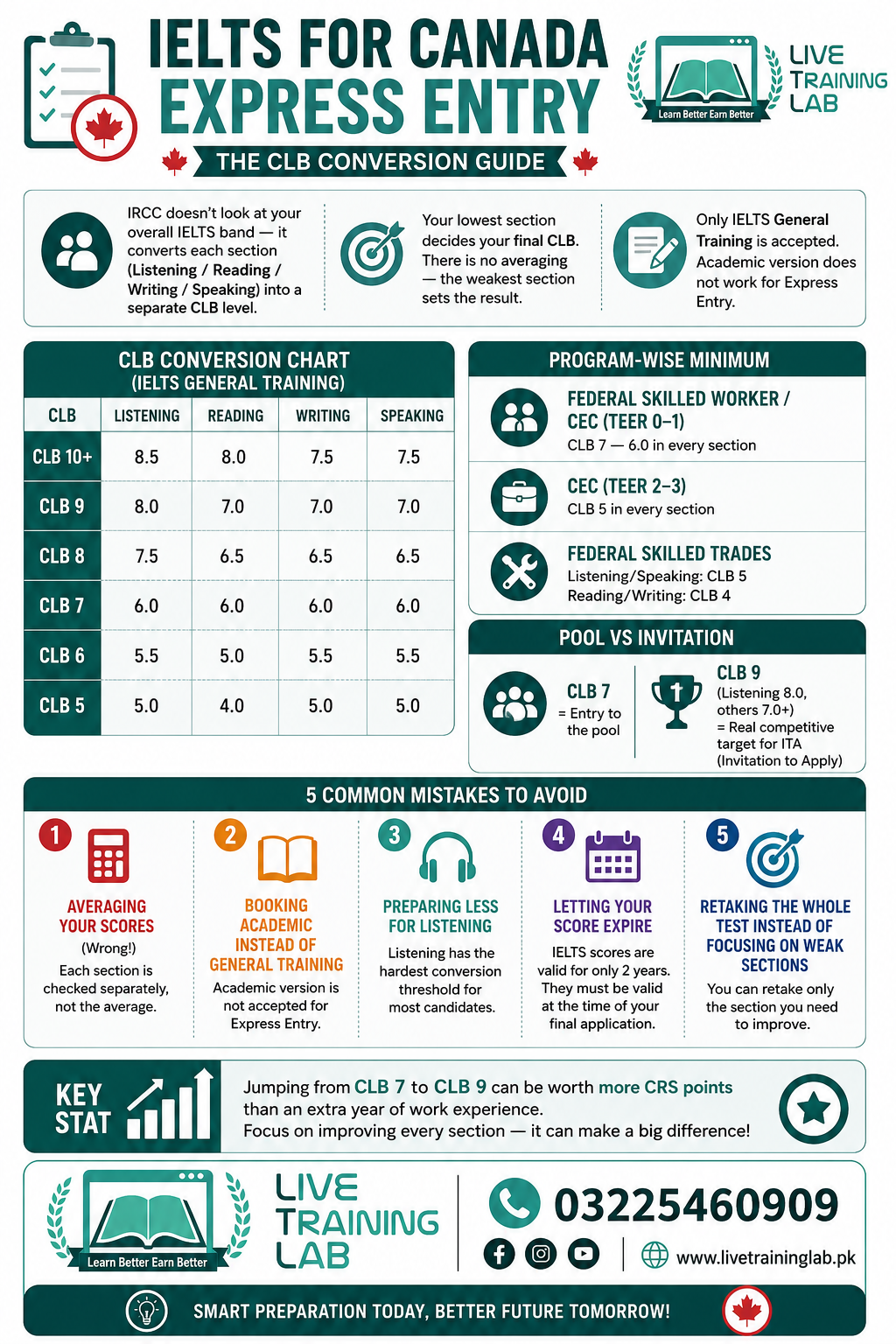
For Canada’s Express Entry, your overall IELTS band score is not what matters most. IRCC evaluates each section, Listening, Reading, Writing, and Speaking, separately using the CLB system, and your lowest-performing section can affect your final eligibility. Knowing the correct CLB requirements, avoiding common mistakes, and focusing on weak areas can significantly improve your CRS score and increase your chances of receiving an Invitation to Apply (ITA).

Why Your IELTS Band Score Isn’t the Number That Actually Matters
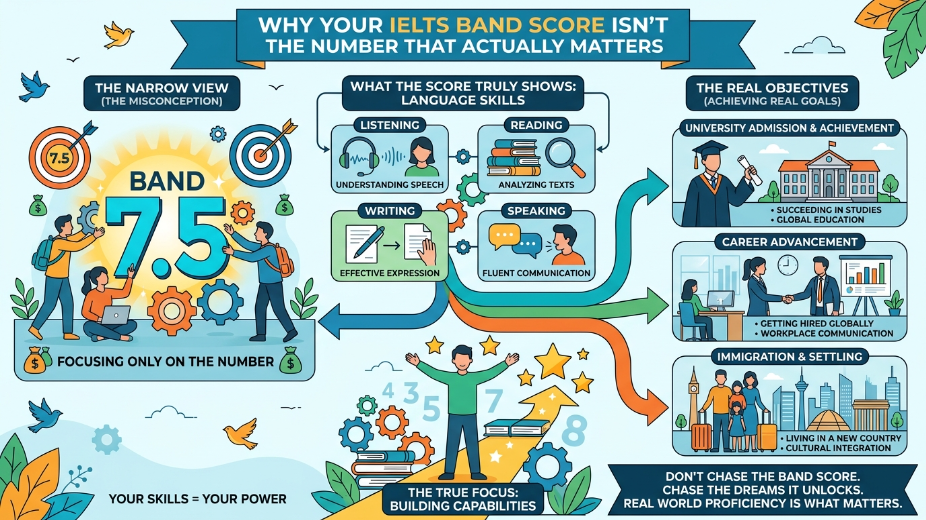
Here’s what surprises most applicants testing in Lahore, Karachi, Islamabad, or anywhere else in Pakistan: IRCC (Immigration, Refugees and Citizenship Canada) doesn’t care about your overall IELTS band at all. A shiny overall band of 7.0 means nothing on its own for Express Entry.
Instead, IRCC takes your four individual scores Listening, Reading, Writing, and Speaking and converts each one separately into its own CLB level. Whichever section scores lowest becomes your weakest link, and that’s the score that decides your eligibility. Score 7.5 in three sections, but only 5.5 in Writing, and your entire application gets pulled down to the CLB level that 5.5 represents.
This is exactly why applicants with a decent “overall” score sometimes get rejected from the pool. They never checked their weakest section on its own.
What Is CLB, and Why Does IRCC Use It Instead of Your IELTS Score?
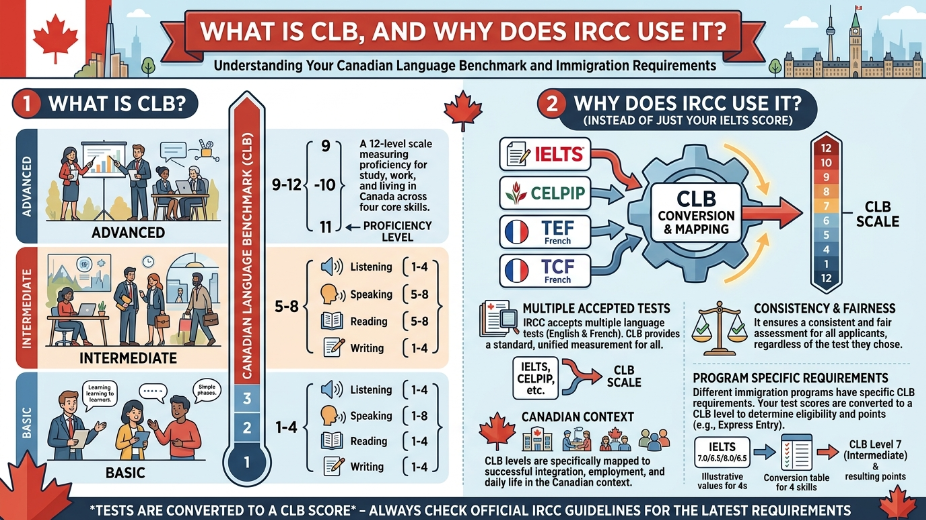
CLB stands for Canadian Language Benchmark. It’s a 12-point scale IRCC uses to standardize every accepted English test IELTS, CELPIP, PTE Core onto one common measuring stick. That way, whether you tested with IELTS in Faisalabad or CELPIP in Toronto, immigration officers can compare English ability on equal footing.
One detail catches a lot of people off guard: only IELTS General Training is accepted for Express Entry. If you sat the IELTS Academic version the one most students take for university admissions it will not count here, no matter how high the score. You’ll need to book a fresh General Training attempt.
IELTS to CLB Conversion Chart for Express Entry (2026)
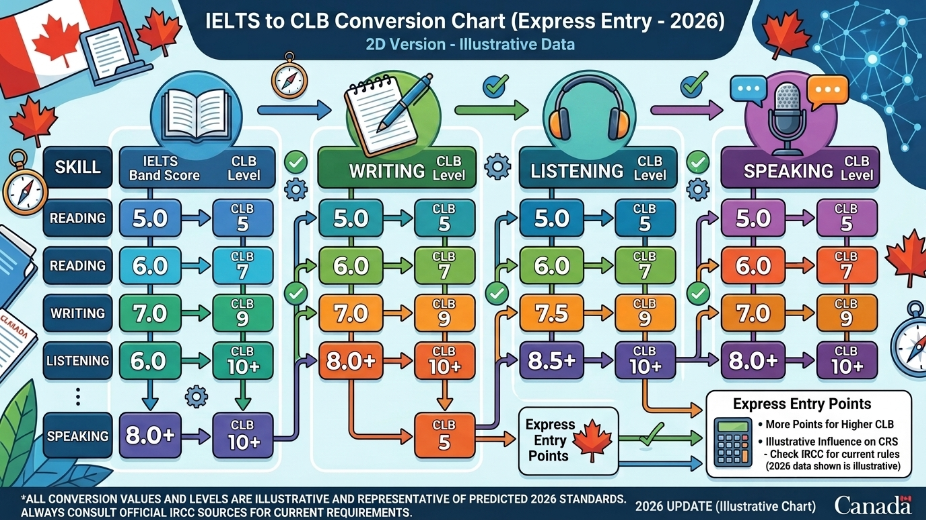
Here’s the conversion IRCC uses, broken down skill by skill. Each one is checked on its own never averaged.
- CLB 10 and above: Listening 8.5, Reading 8.0, Writing 7.5, Speaking 7.5
- CLB 9: Listening 8.0, Reading 7.0, Writing 7.0, Speaking 7.0
- CLB 8: Listening 7.5, Reading 6.5, Writing 6.5, Speaking 6.5
- CLB 7: Listening 6.0, Reading 6.0, Writing 6.0, Speaking 6.0
- CLB 6: Listening 5.5, Reading 5.0, Writing 5.5, Speaking 5.5
- CLB 5: Listening 5.0, Reading 4.0, Writing 5.0, Speaking 5.0
Notice something odd? Listening needs a full 8.0 to reach CLB 9, while Reading only needs 7.0 for that same level. This is exactly where applicants lose points without realizing it they assume every section converts the same way, and it doesn’t.
The Exact Band Score You Need for Express Entry in 2026
The Minimum to Enter the Pool
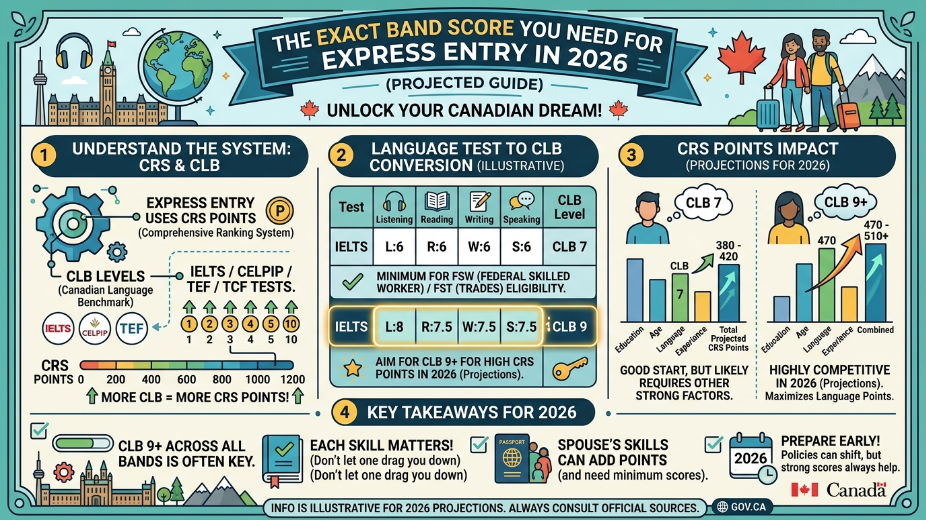
To qualify for Express Entry through the Federal Skilled Worker Program, or the Canadian Experience Class for TEER 0 or TEER 1 jobs, you need CLB 7 to a 6.0 in every single section of IELTS General Training, in one sitting. Not an average of 6.0. Six full bands each in Listening, Reading, Writing, and Speaking.
If you’re applying under the Canadian Experience Class for a TEER 2 or TEER 3 job, the bar drops to CLB 5. The Federal Skilled Trades Program is lower still, asking for CLB 5 in Listening and Speaking, and CLB 4 in Reading and Writing.
The Realistic Target: If You Want an Invitation
Here’s the honest part: CLB 7 gets you into the pool, but it rarely gets you an Invitation to Apply on its own. Express Entry in 2026 has been running mostly through category-based and program-specific draws rather than general rounds, and cut-off scores have consistently sat well above what CLB 7 alone provides.
If you’re serious about receiving an ITA, aim for CLB 9 that means 7.0 or higher in Reading, Writing, and Speaking, and 8.0 in Listening. This single jump from CLB 7 to CLB 9 is one of the highest-value moves in your entire CRS profile, often worth more points than an extra year of skilled work experience.
How Your IELTS Score Impacts Your CRS Points
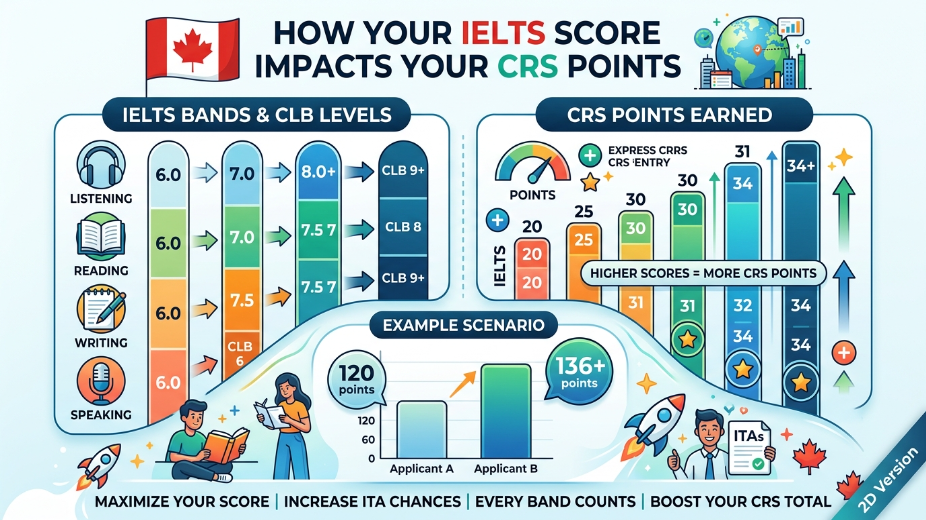
Language is one of the biggest levers in the Comprehensive Ranking System, right up there with age and work experience. Every CLB level you climb adds points, and pairing a strong CLB with foreign work experience or a Canadian credential can unlock further points on top.
In practical terms, two candidates with the same age, education, and work history can end up dozens of CRS points apart purely because of language. That gap is often exactly what separates an Invitation to Apply from another few months of waiting in the pool.
Before you finalize your profile, run your numbers through IRCC’s official CRS tool on canada.ca once you know your CLB it takes a few minutes and removes the guesswork.
IELTS General Training vs Academic: Don’t Get This Wrong
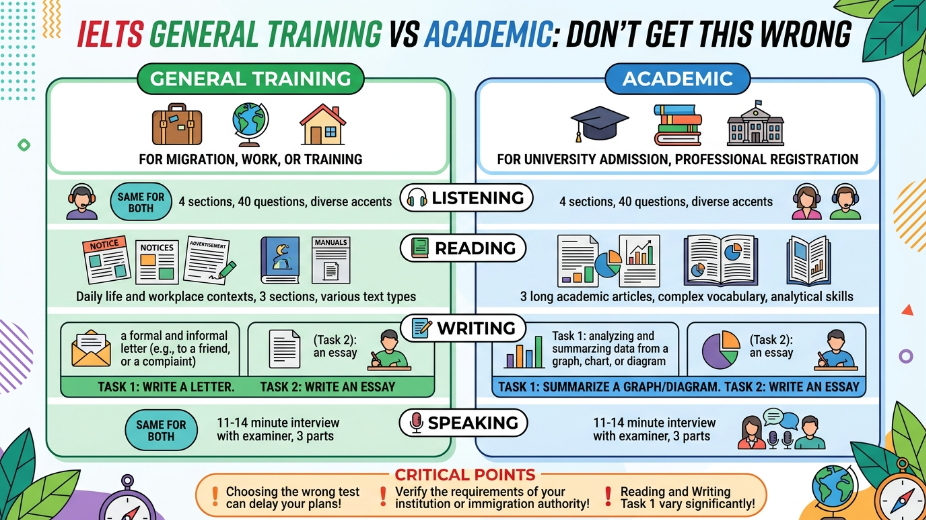
This trips up more applicants than anything else on this list. If you took IELTS Academic for a university application and assume the same score works for Express Entry, it doesn’t. IRCC only accepts General Training for economic immigration programs the reading passages, writing tasks, and even parts of the scoring criteria differ between the two versions.
Booking the correct version from the start saves you weeks of preparation time and the cost of a retake.
Common Mistakes Pakistani Applicants Make With IELTS for Express Entry
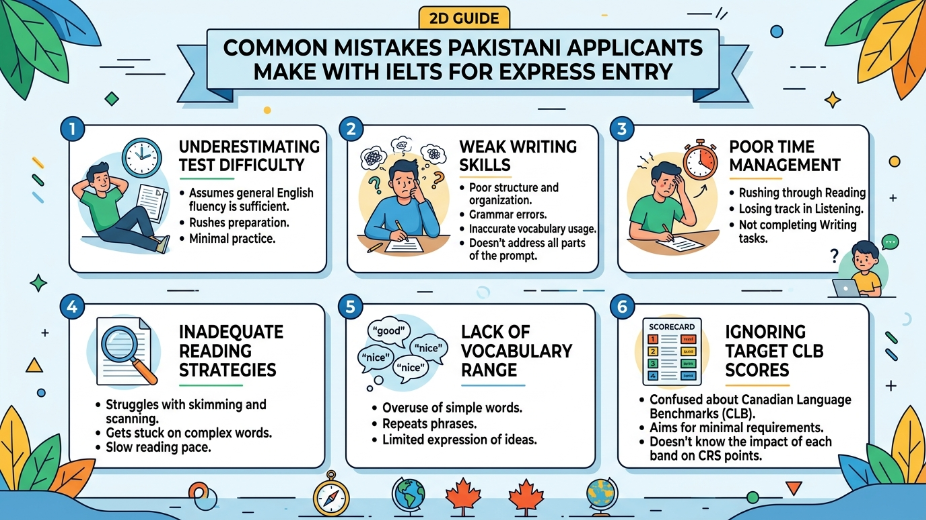
- Averaging their scores. An overall band of 7.0 doesn’t guarantee CLB 7 in every section check each one individually.
- Booking Academic instead of General Training. Always confirm with your test centre before you register.
- Under-preparing for Listening. It has the toughest conversion thresholds of the four skills, yet most students spend the least time practising it.
- Letting scores expire. IELTS results are valid for two years, and they need to be still valid when you submit your final application not just when you enter the pool.
- Retaking the whole exam instead of targeting the one weak section. If Writing is holding you back, focus your prep there rather than starting from zero.
How to Reach Your Target Band Score

- Take a full mock test first, so you’re working from your real starting point instead of a guess.
- Identify your weakest of the four skills and give it the most study hours not the one you enjoy most.
- Practise listening under real exam conditions. It has the least room for error at the higher CLB levels.
- Read and write in English daily, even in small amounts. Consistency beats a last-minute cramming session.
- Get your Writing checked by someone who knows IELTS band descriptors, not just a fluent English speaker the criteria are specific.
- Book your test date with enough buffer before your planned Express Entry submission, so your results don’t expire mid-process.
Frequently Asked Questions:
1. What is the minimum IELTS band score for Canada Express Entry in 2026?
You need at least 6.0 in each of the four sections Listening, Reading, Writing, and Speaking which equals CLB 7. That’s the minimum for the Federal Skilled Worker Program and most Canadian Experience Class applications.
2. Is IELTS Academic accepted for Express Entry?
No. IRCC only accepts IELTS General Training for Express Entry and other economic immigration programs. IELTS Academic isn’t valid here, even with a high band score.
3. What CLB level do I need for a competitive CRS score?
CLB 9, roughly 7.0 to 8.0 across all four sections, puts you in a much stronger position than the CLB 7 minimum, especially with recent Express Entry draws favouring higher-scoring profiles.
4. How long is my IELTS score valid for Canadian immigration?
Two years from your test date. Your score needs to still be valid, not just when you enter the Express Entry pool, but also when you submit your final permanent residence application after receiving an ITA.
5. Can I use my overall IELTS band score instead of my individual section scores?
No. IRCC converts each of your four section scores into a CLB level separately, and your lowest section determines your overall CLB no matter how high the other three are.
Your IELTS score is one of the few parts of your Express Entry profile you can directly control and improve, unlike your age or your job history. Get your CLB right, and you’re not just meeting a minimum requirement you’re building the strongest possible foundation for your CRS score. Whether you’re testing from Lahore, Karachi, Rawalpindi, Multan, or Faisalabad, the rules are the same everywhere: know your target CLB, prepare with an actual plan, and don’t leave your weakest section to chance.
Strong English communication matters well beyond exam day, too Live Training Lab’s Spoken English course is built to help you speak with real confidence, whether that’s for your IELTS Speaking section or your first workplace conversation in Canada. Visit livetraininglab.pk to see what else could fit your plan.