

Master IELTS Speaking: Band 9 Cue Card Answers That Impress
Picture two students answering the same cue card. One talks for barely a minute, pauses awkwardly, and repeats “very good” and “nice” a few times before finishing with a shrug. The other speaks for close to two minutes without losing the thread, using natural phrases like “to be honest” and “what really stood out was.” Same topic, same one minute of prep time, completely different score.
Below are real, example-style Band 9 answers for some of the most common cue card topics, plus a breakdown of what separates a Band 9 response from an average one. Whether you’re preparing in Lahore, Karachi, Islamabad, or anywhere else in Pakistan, these examples give you something concrete to build your own answers around.
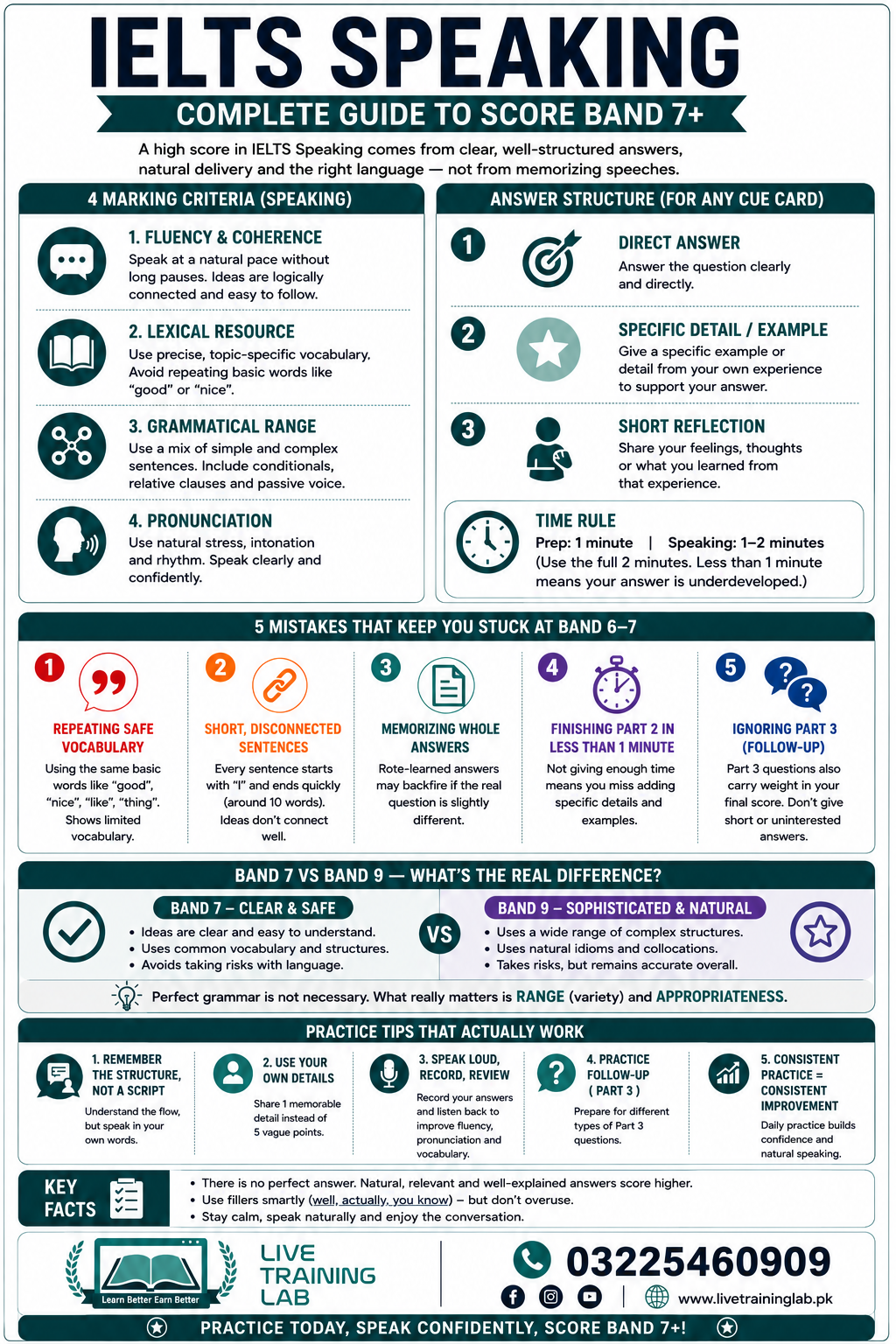
Speak Naturally, Score Higher
A high IELTS Speaking score is not about using difficult words or memorizing answers. It comes from speaking confidently, organizing your ideas clearly, and responding naturally. By understanding the marking criteria, using a simple answer structure, and practicing regularly with feedback, you can improve your fluency, vocabulary, pronunciation, and grammar to achieve Band 7 or higher.

What Actually Makes a Speaking Answer “Band 9”?
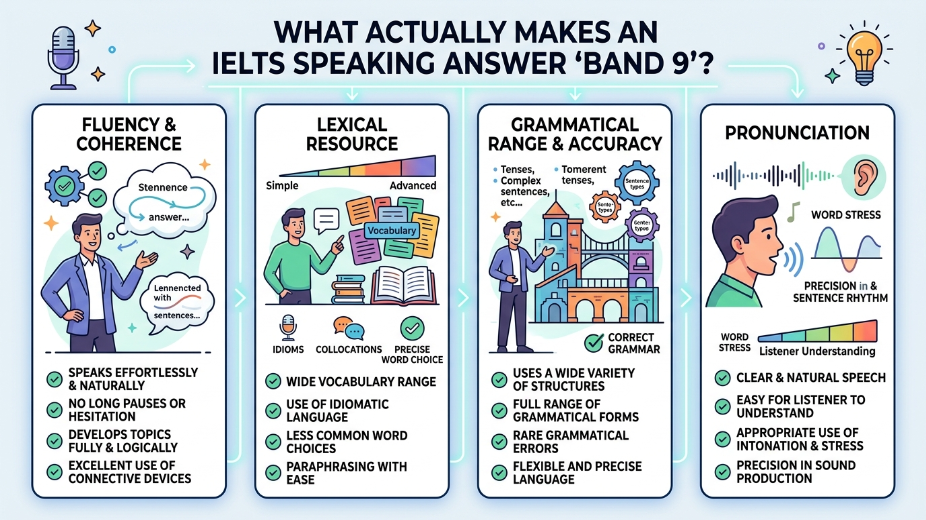
Examiners aren’t scoring you on how clever your ideas sound. They’re marking four things: fluency and coherence, lexical resource, grammatical range, and pronunciation. A Band 9 answer ticks all four boxes at once, not just one or two.
- Fluency and coherence: natural pace, no long pauses to search for words, ideas that connect logically.
- Lexical resource: precise, topic-specific vocabulary instead of the same three or four adjectives on repeat.
- Grammatical range: simple and complex sentences used without thinking, including conditionals, relative clauses, and passive voice.
- Pronunciation: stress, intonation, and rhythm that sound natural, so a listener never has to strain to understand you.
None of this comes from memorizing vocabulary lists the night before your test. It comes from being genuinely comfortable speaking about everyday topics, which is exactly why practicing with real cue cards matters so much.
Real Band 9 Answers for Common Cue Card Topics
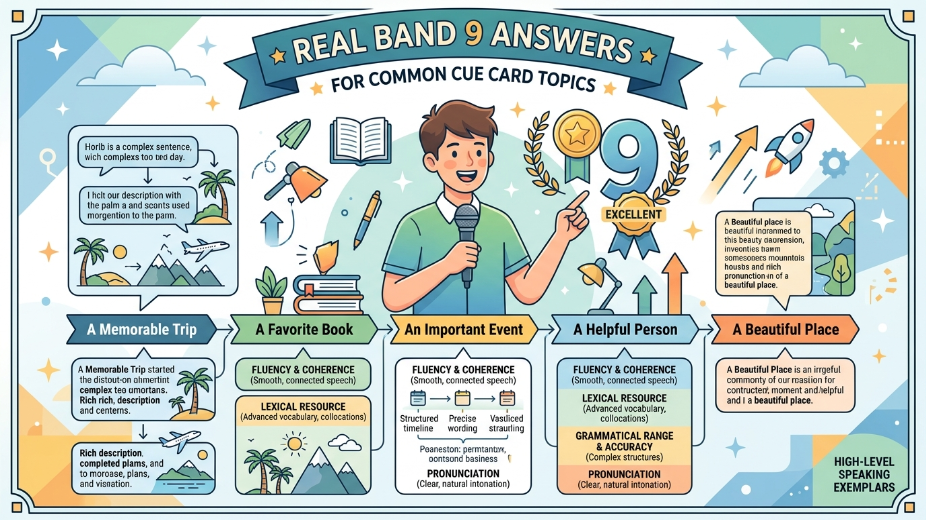
The samples below follow the standard Part 2 format: a cue card prompt, followed by a full answer in the style you’d hear from a high-scoring candidate. Try reading them aloud it makes the rhythm easier to absorb than silent reading does.
Cue Card: Describe a Person Who Has Inspired You
You should say: who this person is, how you know them, what they have done, and explain why this person inspires you.
“Well, if I had to pick one person who’s truly inspired me, it would be my elder sister, Ayesha. She studied medicine against fairly tough financial odds our family wasn’t well-off, so she juggled part-time tutoring alongside her studies for nearly six years, and never once complained about the hardship. She treated every setback as a stepping stone rather than a stumbling block. These days, she runs a small clinic near Multan, where she often treats patients who can’t afford proper healthcare, sometimes waiving her fee entirely. The reason she inspires me so deeply is that she embodies resilience without ever becoming bitter about it. Whenever I’m tempted to give up on something, I think of her sheer determination, and that gives me the push I need to carry on.”
Cue Card: Describe a Memorable Journey You Have Been On
You should say: where you went, who you went with, what happened during the journey, and explain why it was memorable.
“The journey that comes to mind straightaway is a road trip up to Hunza Valley with three university friends, the summer before our final year. Half of it ended up completely improvised. What made it unforgettable wasn’t really the scenery, though the mountains up there are jaw-dropping, but rather the moment our van broke down just past Naran, fairly late in the evening. We were stranded for nearly three hours with no phone signal. Instead of panicking, we sat by the roadside, sharing biscuits and telling stories under the clearest night sky I’ve ever seen. A local family eventually spotted us and towed us to the nearest village, refusing any payment for the trouble. That mix of frustration and the kindness of strangers is really what stuck with me.”
Cue Card: Describe a Skill You Would Like to Learn
You should say: what the skill is, why you want to learn it, how you would learn it, and explain how this skill would benefit you.
“If I could dedicate myself to mastering any new skill right now, I’d probably go for video editing. It’s something I’ve dabbled in on and off, but never with real discipline. My interest was sparked, oddly enough, by watching travel vloggers online turning a chaotic day of footage into something genuinely gripping fascinates me. I’d likely start with a structured online course rather than scattered tutorials, since I lose motivation without a clear syllabus. In terms of benefits, it would open up a fairly practical side income, since so many small businesses now need short promotional clips for social media. Beyond the financial angle, there’s something deeply satisfying about telling a story visually instead of only through words.”
Cue Card: Describe a Piece of Technology You Find Useful
You should say: what it is, how often you use it, how you learned to use it, and explain why you find it useful.
“The piece of technology I honestly couldn’t manage without is my phone’s translation app, believe it or not. I use it almost daily for work, since I occasionally correspond with clients who don’t speak English fluently. I picked it up more or less by accident a colleague recommended it a couple of years ago when I was struggling to communicate with a supplier on a business trip. What I find most useful isn’t just the text translation, but the real-time voice feature, which lets you hold a conversation almost naturally. It’s saved me from more than a few awkward misunderstandings, frankly, and made me a bit more adventurous about exploring content in other languages, since the barrier to understanding it has basically disappeared.”
How to Use These Answers Without Sounding Memorized
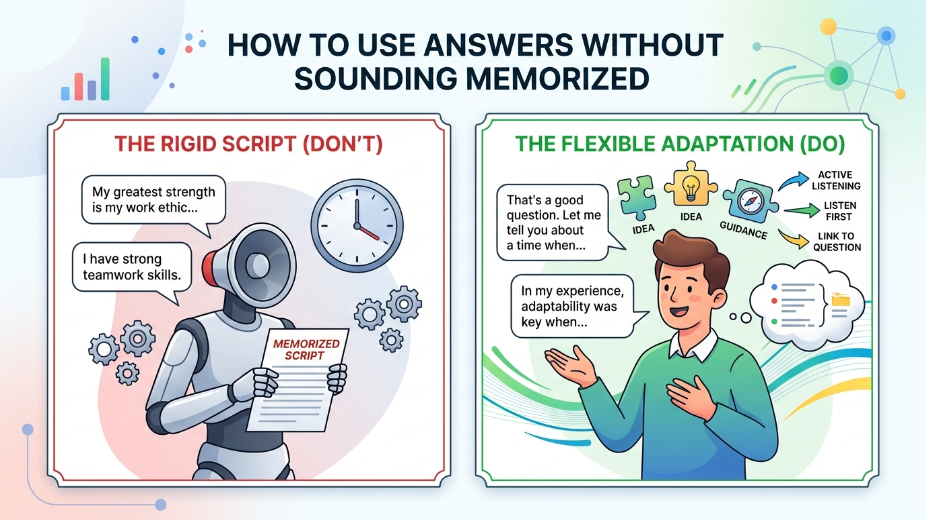
Examiners talk to hundreds of candidates every month, and a memorized answer is easy to spot the rhythm changes, pauses disappear at the wrong moments, and the content doesn’t quite match the question. Instead of learning these answers word for word, try this:
- Study the structure, not the script: Direct answer, specific detail, short reflection a pattern that fits almost any cue card topic.
- Swap in your own details: Keep the habit of using one memorable detail instead of five vague ones.
- Practice out loud, not in your head: Time yourself: one minute to prepare, two minutes to speak.
- Record yourself and listen back: It’s the fastest way to catch filler words or a flat tone.
- Get comfortable with follow-up questions: Part 3 pushes you to defend your Part 2 answer, so practice explaining opinions too.
Common Mistakes That Keep Students Stuck at Band 6 or 7
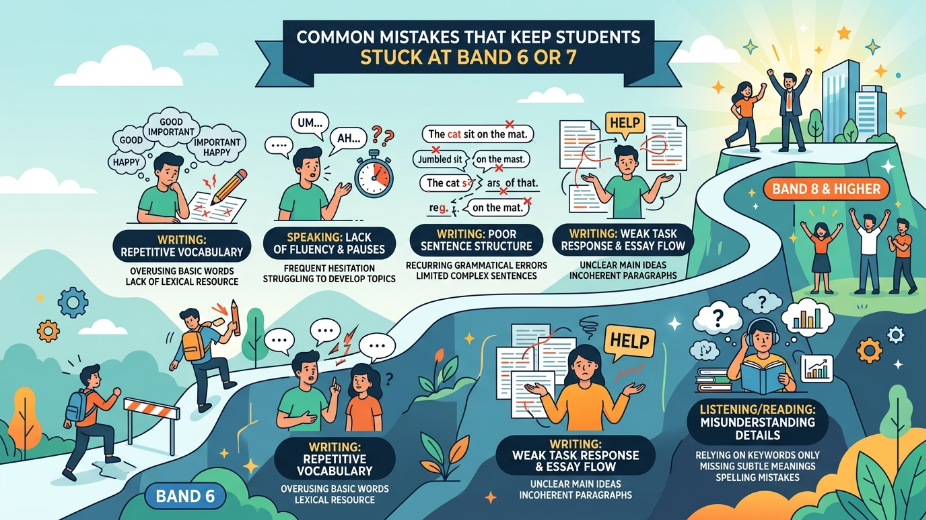
Most students preparing for IELTS Speaking in Pakistan, whether in Lahore, Rawalpindi, or Faisalabad, aren’t lacking English ability they’re repeating a handful of fixable habits under exam pressure:
- Relying on the same safe vocabulary: Words like “good” and “nice” aren’t wrong, but overusing them signals a limited range.
- Speaking in short, disconnected sentences: If every sentence starts with “I” and stops after ten words, your grammar score suffers even when each one is correct.
- Memorizing full answers word for word: It backfires the moment the real question differs slightly from what you prepared.
- Rushing through Part 2 in under a minute: You have up to two minutes use them, and add a specific example.
- Ignoring Part 3 preparation: It carries real weight in your final score too, not just the cue card.
Frequently Asked Questions
Can I memorize answers and use them directly in the IELTS Speaking test?
Not word-for-word. Examiners notice unnatural pauses and mismatched content. It’s safer to memorize useful structures and vocabulary, then build your answer live, based on the card you’re given.
How long should a Part 2 cue card answer be?
Aim for one to two minutes. Under a minute means you haven’t developed the answer enough; well past two minutes, the examiner moves you on to Part 3.
What’s the real difference between a Band 7 and a Band 9 answer?
It’s rarely about “better” ideas. A Band 7 answer is clear and mostly accurate but plays it safe. A Band 9 answer takes more risks with complex structures and natural idioms, and still gets nearly everything right.
Do I need perfect grammar to score Band 9?
No, occasional slips are normal even at Band 9. What matters more is range using varied structures accurately, rather than sticking to simple sentences to avoid mistakes.
How can I practice speaking without a partner?
Recording yourself on your phone works surprisingly well. A structured speaking class helps too, since regular feedback moves students forward faster than solo practice, especially if you’ve been stuck at the same score for a while.
Band 9 speaking isn’t about having a larger vocabulary than everyone else or memorizing clever phrases. It’s about being genuinely comfortable talking through ordinary topics a person, a trip, a skill, a gadget in a natural, connected way. The examples above are a starting point; real progress happens once you build your own answers using the same techniques: specific details, natural structure, and honest reflection instead of rehearsed lines.
If you’d like structured practice with real feedback instead of guessing where you stand, Live Training Lab runs an online Spoken English course built around this kind of speaking practice check the details at livetraininglab.pk.