- Build Real Websites & Web Apps from Scratch
- Become Full Stack Developer (Frontend + Backend)
- Learn React, Node, MongoDB & Express
- Start Freelancing & Earn from Web Development
- Work on Real Projects During Training
- Create Portfolio to Get Developer Jobs
- Learn API Development & Database Management
- High Demand Skill for IT Jobs & Remote Work
MERN Stack Developer Course

🎯 Learn Full Stack Development & Get Developer Jobs
Live Online MERN Stack Training to Build Real Web Applications & Start Freelancing or Job Career
The Role of a MERN Stack Developer:
A MERN stack developer builds both halves of a web application: the part users click on and the part that stores and serves the data. The four pieces are MongoDB, Express, React and Node.js. The MEAN stack is the same idea with Angular in place of React.
What makes the stack popular is that all four pieces speak JavaScript, so you are not switching languages between the browser and the server. MongoDB stores your data without a rigid table structure. Express handles routes and requests. React builds the interface. Node runs your JavaScript on the server.
In practice that means pages which update without reloading, data saved and read back quickly, and one codebase that behaves on a phone as well as a laptop. It is the reason so many startups and small teams pick MERN over a split stack.
What Is the MERN Stack?
MERN stands for:
M – MongoDB (a NoSQL database)
E – Express.js (a web application framework)
R – React.js (a JavaScript library for building user interfaces)
N – Node.js (a JavaScript runtime environment)
Put simply, MERN is four tools that fit together: MongoDB for the database, Express for the server routes, React for the interface, and Node for running JavaScript outside the browser. Learn them together and you can build an entire application on your own, which is exactly what the course sets out to do.
A MERN developer typically handles the interface, the API, the database schema and the deployment. That breadth is why the role suits freelancers and small teams, and why one person can take a project from an idea to something live.
What Our MERN Stack Course Covers
The LiveTrainingLab MERN Stack Developer Course runs live over 4 weeks, in a small batch, with a trainer who builds with these tools outside the classroom.
You start with JavaScript itself, since everything in the stack depends on it, and then take the four pieces one at a time, building something with each before moving on.
The first sessions cover how the pieces connect: a request leaves the browser, reaches an Express route on Node, pulls data from MongoDB and comes back to a React component. Once that path makes sense, the rest of the course is filling it in.
Along the way you set up your development environment, model and query data in MongoDB, build components, props and state in React, write REST APIs in Express, handle authentication, and deploy the finished application so somebody else can use it.
Sessions are hands-on rather than lectured. Your trainer sets a task in each class, watches your screen while you work on it, and goes through the errors with you before the session ends.
By the end of the 4 weeks you will have built a full-stack application of your own, front end, API and database together, and put it somewhere people can reach it. That project is what goes into your portfolio.
How the Live Online Classes Run
Wondering how an online class works for something this hands-on? Here is what a session looks like.
You join from home, but the class itself runs at a fixed batch time with everyone present. That set slot is deliberate, since a trainer expecting your code is what keeps people finishing rather than drifting off in week two.
Your trainer builds alongside you, explaining not just what each piece does but why it sits where it does, which is the part that makes the next project easier.
Practical work covers npm and the toolchain, MongoDB collections and queries, Express routing and middleware, React components, hooks and state, and Node handling everything on the server side.
Every concept is followed by something to build with it, so the theory never floats free of the code. By week three you are working on one continuous project rather than isolated exercises.
You also get the course material and project files to keep, and your batch group stays useful long after the 4 weeks for asking questions and sharing work.
MERN Stack Classes Taught in Urdu
The whole MERN stack course can be taught in Urdu. Because every class is live and online, students join the same batch from anywhere in Pakistan rather than only from one city.
Technical ideas land faster in the language you think in. Your trainer teaches in Urdu or English and switches mid-session when it helps, so nothing gets lost while you are trying to follow both the code and the explanation.
Beginners and people who already write JavaScript both join these batches. Tell your trainer where you stand at enrolment and the early sessions are pitched accordingly.
Ask us for the next batch timing and we will tell you exactly how the 4 weeks run, what you build each week, and what you keep at the end.
How Our Live MERN Stack Classes Work
Every session is taught live by a trainer at a fixed time, with a small batch. You have your editor and terminal open and you build along with the class, so components, routes and queries get written while somebody is there to check them. Share your screen and the trainer can read the stack trace with you rather than leaving you to search for it.
Questions get answered as they come up, in English or Urdu. Each class ends with something to build, and the next one opens by reviewing what you produced. Over 4 weeks that leaves you with one working application rather than four disconnected tutorials.
Why a Live Class Beats Piecing MERN Together Yourself
Each part of the stack has good free material, and that is exactly the trap. You finish a React course, then a Node one, and still cannot get the two talking to each other. The joins are where self-taught MERN developers get stuck: CORS errors, authentication tokens, a database connection that works locally and not once deployed.
A trainer who has hit all of those already saves you weeks. You also build one project end to end instead of four unrelated demos, which is what an employer or client actually wants to see.
Batches, Timings and the 4-Week Plan
The MERN course runs over 4 weeks. Week one covers modern JavaScript, the toolchain, npm and the development setup, plus Node basics. Week two is the back end: Express routing and middleware, REST API design, MongoDB collections, queries and Mongoose. Week three moves to React, including components, props, state, hooks, routing and connecting the front end to your API. Week four covers authentication, file uploads, error handling, deployment and your final full-stack project.
Batches run morning and evening so students and working people can both find a slot. Your timing is confirmed at enrolment, and the trainer stays reachable through the course.
Who This MERN Stack Course Is For
Front-end developers who can build interfaces but not the API behind them. Back-end developers who want to stop depending on someone else for the interface. Graduates aiming at full-stack or remote developer roles. Freelancers who keep turning down projects that need a database and a login. Anyone with a product idea and nobody to build it.
Some JavaScript is genuinely needed before you start, particularly functions, arrays and objects. If yours is rusty, say so at enrolment and your trainer will point you at what to revise before week one.
Every class is live. Your trainer teaches in real time, watches your shared screen while you code, and debugs with you in the same session. Nothing is a replay of an older batch.
The course runs over 4 weeks of live classes, covering Node and Express, MongoDB, React and deployment, and finishing with a full-stack project. You keep the material and project files afterwards.
Yes, some. The whole stack is JavaScript, so functions, arrays, objects and promises should be familiar. You do not need to be advanced. Tell your trainer your level at enrolment and the first week will fill the gaps.
Yes. Your trainer teaches in English or Urdu and switches between them mid-session when it helps someone follow. Ask your question in whichever language you think in.
A working full-stack application with a React front end, an Express API, a MongoDB database and user authentication, deployed somewhere others can reach it. That project is what goes into your portfolio.
Tell your trainer as early as you can. You will be given the material and the task for that session, and the trainer will cover the gap with you at the start of the next class so you stay with the batch.
Batches are kept small on purpose. Reading individual code and debugging with each student does not work in a crowded class. Ask us for the current batch size when you enquire.
A laptop or desktop with a reasonable amount of memory, a steady internet connection and a headset. Classes run on Zoom, so the app or a browser is enough to join. Your trainer will help you install Node, MongoDB and an editor in the first session.
Course Schedule
| Start Date | Time | Seats Left | Price | |
|---|---|---|---|---|
| 27-Aug-26 : Thu | 10:00 AM | 3 | 15999 Rs | Register Now |
| 28-Aug-26 : Fri | 12:00 PM | 1 | 15999 Rs | Register Now |
| 29-Aug-26 : Sat | 02:00 PM | 1 | 15999 Rs | Register Now |
| 31-Aug-26 : Mon | 06:00 PM | 5 | 15999 Rs | Register Now |
| 01-Sep-26 : Tue | 08:00 PM | 2 | 15999 Rs | Register Now |
| 02-Sep-26 : Wed | 10:00 PM | 1 | 15999 Rs | Register Now |
| 03-Sep-26 : Thu | 04:00 PM | 4 | 15999 Rs | Register Now |
We provides this course in following city of Pakistan
- Karachi
- Islamabad
- Rawalpindi
- Azad Kashmir
- Lahore
- Sialkot
- Gujranwala
- Multan
- Gujrat
- Faisalabad
- Sahiwal
and other major cities in Pakistan.


100% online courses
Start instantly and learn at your own schedule.

Flexible Schedule
Set and maintain flexible deadlines.

Learn the latest skills
with on-demand training and development programs

Shareable certificate
Earn a Certificate upon completion
Shareable on Social Media
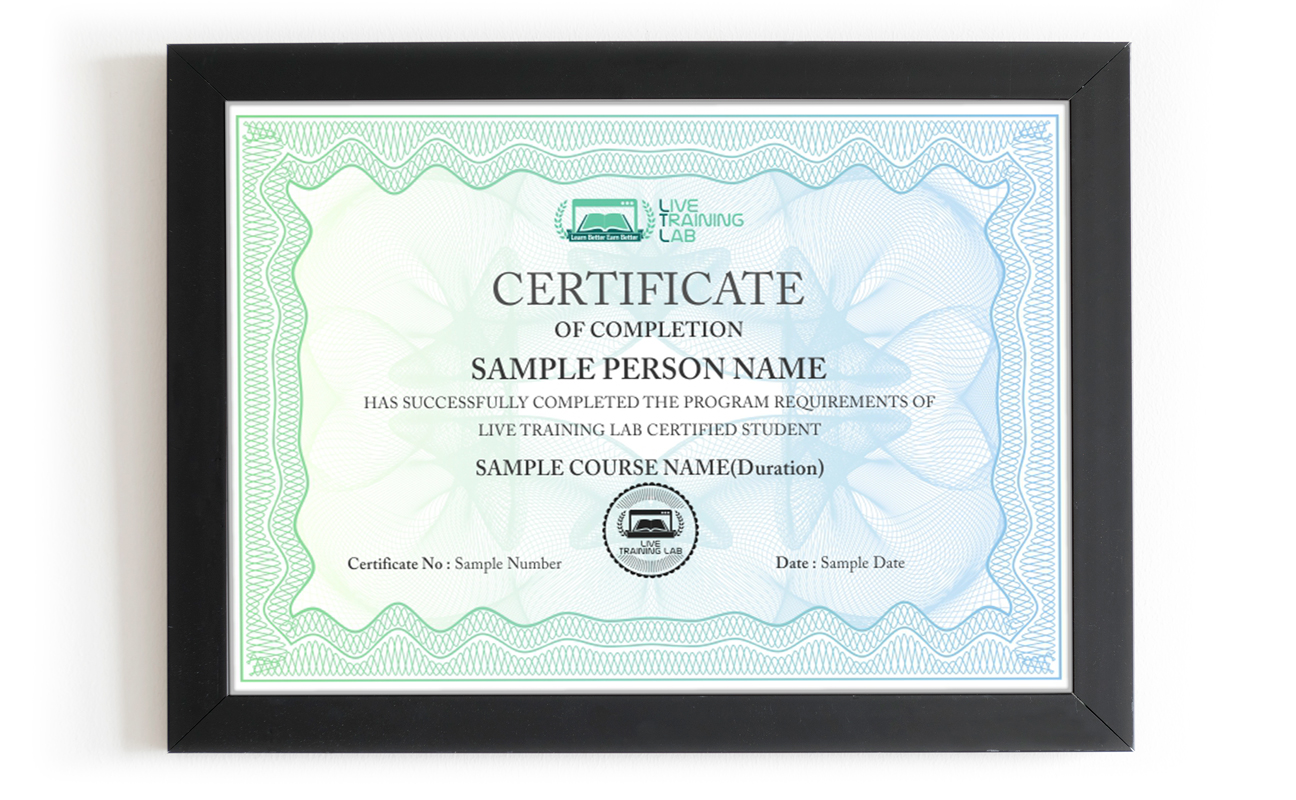
You can share your Certificate in the Certifications section of your social profile, on printed resumes, CVs, or other documents.
₨32,000.00₨16,000.00