
- Build Dynamic Websites & Web Applications from Scratch
- Learn PHP with MySQL Database Integration
- Start Freelancing as a Web Developer
- Work on Real Projects During Training
- Learn Backend Development Step-by-Step
- Create Forms, Login Systems & Dynamic Features
- Get Complete Guidance to Become Job-Ready Developer
- High Demand Skill for Web Development Jobs
PHP Programming Course In Pakistan
🎯Learn PHP & Become a Professional Web Developer
Live Online PHP Training to Build Dynamic Websites, Work with Databases & Start Freelancing or Web Development Jobs
PHP Developer Course
What is a PHP programming course?
Looking for a PHP course near you? Ours runs live and online, so you join at your batch time, write the code along with your trainer, and get errors found on the spot instead of guessing alone.
PHP is a widely used programming language created for websites that is easy to implement, quick to learn, and delivers substantial functionality to design and develop e-commerce. This hands-on PHP programming course takes you through building dynamic, database-driven pages in PHP. You write the code yourself in every live session over 4 weeks, with your trainer watching the screen rather than sending you a video afterwards.
In this course, students will get a brief introduction to the PHP framework, syntax, and master-level techniques used to design and develop websites. Students will learn to perform hands-on practice with a MySQL database to build database-driven HTML forms and reports. Potential students will also learn how to connect to an ODBC-compliant database and how to configure PHP and the Apache Web Server. Ecommerce skills, including user authentication, data validation, dynamic data updates, and shopping cart implementation, are briefly covered in detail.
Learn PHP in a complete course taught live online. By the end you can build a working, database-driven website: forms that save data, a login that keeps users signed in, and pages that pull their content from MySQL.
PHP runs on the server, which is what lets a site store data, check a password or build a page from a database. Some HTML and CSS knowledge helps before you start, since PHP produces the markup a browser eventually shows. The syntax itself is close to C, so it reads logically once you get past the first week.
Importance of PHP Programming:
PHP is free and open source, so there is nothing to buy before you start and the documentation is public. It handles the back end, the part of a site your visitors never see but rely on for every login, order and saved form.
- PHP is considered one of the easiest scripting languages.
- PHP is highly flexible, whether it is during an ongoing project or after completing the project.
- PHP performs efficiently.
- PHP programming is cost-efficient programming.
- PHP programming gives more control to the web developer.
The course starts with how a web application is put together and how the browser and server talk to each other. From there you cover variables, data types, logic, arrays, error handling and superglobals, then move on to files, MySQL and sessions. PHP work is steady in Pakistan and abroad, particularly maintenance and custom features on existing sites.
Whether you want to run your own business site or work as a developer, LiveTrainingLab has a live 4-week course that takes you there step by step.
Why Choose Us:
Choosing a direction is the hard part, especially with so much conflicting advice online. LiveTrainingLab teaches PHP as a live class, not a video library. Sessions run in small batches at fixed morning and evening timings, so students and working people can both find a slot, and each class ends with something to build before the next one.
LiveTrainingLab is a Pakistan-based institute, and students join our live batches from home, from the office and from outside the country. Your trainer writes PHP for real projects, which is why the debugging advice in class comes from actual work rather than a textbook. Sit in on a live session before you enrol and judge the teaching yourself.
Beginners and working professionals both sit in our batches, and the syllabus starts from the basics either way. Ask us about the next batch if you want to start working towards becoming a confident PHP developer with projects to show.
Benefits of PHP Courses
Learning about the development of websites by taking online PHP classes is the best first step to an enjoyable career in this field. If you’d like to not learn a range of individual programming languages completely from scratch and start from scratch, you won’t have any other choices other than to devote months or years to learning each programming language. The fact is that there are lots of benefits that can be gained from learning PHP and other web-based scripting languages on the internet instead of studying in a classroom. Let’s look at the benefits.
The obvious benefit of an online PHP course is that you skip the travel. The class itself still runs at a fixed batch time, and that is deliberate, because a set slot with a trainer expecting your code is the reason people finish instead of drifting off in week two. This can be extremely helpful for those who want to kick-start their careers in the shortest time possible and master the art of developing web applications swiftly. However, if it is a good idea to master a specific programming language and you want to use it in numerous web-based applications, taking the best PHP course is a great choice since you’ll learn all the fundamental characteristics of the language as well as its many nuances.
Another benefit of taking an online course to learn how to create web-based applications is that you’ll be able to master different features of developing web applications with an experienced PHP expert. Particularly if you take a course with an expert who has a wealth of knowledge of the subject, you can be taught not only the fundamentals of web-based applications but also the more advanced aspects that the programming language offers. This will provide you with a complete picture of the things you should be aware of when starting to develop. Additionally, it’s possible to get a thorough understanding of aspects of programming with these types of courses. The benefits of learning with an online course are convenience, flexibility, and speed.
Looking for somewhere solid to learn PHP? LiveTrainingLab runs live online PHP batches open to students anywhere in Pakistan, so where you live makes no difference to the class you get.
PHP Training Courses
A huge share of the web still runs on PHP, including WordPress, which is why the maintenance and custom work keeps coming. If you are thinking about joining our course and are not sure what it covers or whether it suits your level, the next few lines set it out plainly. The 4-week plan runs from syntax and functions through arrays, files and MySQL to sessions and a final project.
Let’s have a brief but informative session to clear up any confusion!
Build a Real PHP Foundation, Step by Step
You start with PHP syntax, variables and control structures, then move up to functions, arrays, file handling, MySQL and sessions. Sessions are taught live in English or Urdu, with a coding task in each one that your trainer checks while you are still in class. Batches run at fixed times over 4 weeks.
Get Your Certificate After the 4 Weeks
You finish with a LiveTrainingLab certificate for the PHP course, issued once the 4 weeks and the final project are complete. The certificate helps, but the working scripts and the database-driven site you build in class are what a client or an employer will actually ask to see.
Get Hired in leading IT Organizations World Wide
PHP work turns up in plenty of places: WordPress sites needing custom features, small business systems, e-commerce back ends, and maintenance on the enormous number of sites already running it. By the end of 4 weeks you can build and fix those yourself, which is enough to start taking small jobs.
What You Will Learn in These Live Classes
- Creating and modifying a PHP page
- Working with variables and data types
- Using if/elseif/else statements to control processing conditionally
- Creating programs that include for, while, and do loops to process statements repeatedly
- Employing the break, continue, and exit statements to modify default loop behaviors
- Creating arrays
- How to manipulate strings in PHP using the built-in functions
- Maintaining state using cookies, session variables, hidden form fields and query strings
- The fundamental techniques necessary to create a shopping cart solution
- Using SQL to SELECT, INSERT, UPDATE and DELETE data from tables
- Using the phpMyAdmin utility to administer the MySQL database
- Using PHP to manipulate files
- Identifying and handling the three main types of errors that can occur when programming with PHP
How Our Live PHP Classes Work
Every session is taught live by a trainer at a fixed time, with a small batch. You have your editor and local server running and you write the code along with the class, so forms, queries and session handling get built while somebody is there to check them. Share your screen and the trainer can see why a query returns nothing or why the page comes back blank.
Questions get answered as they come up, in English or Urdu. Each class ends with a coding task, and the next one opens by reviewing what you wrote. Over 4 weeks that leaves you with a working database-driven site rather than pages of copied syntax.
Why a Live Class Beats a Recorded PHP Course
PHP fails quietly. A missing semicolon, a wrong database credential, a warning suppressed somewhere, and all you get is a blank page with no clue on it. That moment ends most self-study attempts, usually in the first week of MySQL.
In a live class you share the screen, turn on error reporting, and the cause is found in a minute. More useful than the fix is watching how it was found, because tracing a problem back is most of what separates a developer from someone who has followed a tutorial.
Course Schedule
| Start Date | Time | Seats Left | Price | |
|---|---|---|---|---|
| 27-Aug-26 : Thu | 10:00 AM | 2 | 15999 Rs | Register Now |
| 28-Aug-26 : Fri | 12:00 PM | 3 | 15999 Rs | Register Now |
| 29-Aug-26 : Sat | 02:00 PM | 5 | 15999 Rs | Register Now |
| 31-Aug-26 : Mon | 06:00 PM | 4 | 15999 Rs | Register Now |
| 01-Sep-26 : Tue | 08:00 PM | 4 | 15999 Rs | Register Now |
| 02-Sep-26 : Wed | 10:00 PM | 4 | 15999 Rs | Register Now |
| 03-Sep-26 : Thu | 04:00 PM | 3 | 15999 Rs | Register Now |
We provides this course in following city of Pakistan
- Karachi
- Islamabad
- Rawalpindi
- Azad Kashmir
- Lahore
- Sialkot
- Gujranwala
- Multan
- Gujrat
- Faisalabad
- Sahiwal
and other major cities in Pakistan.


100% online courses
Start instantly and learn at your own schedule.

Flexible Schedule
Set and maintain flexible deadlines.

Learn the latest skills
with on-demand training and development programs

Shareable certificate
Earn a Certificate upon completion
Shareable on Social Media
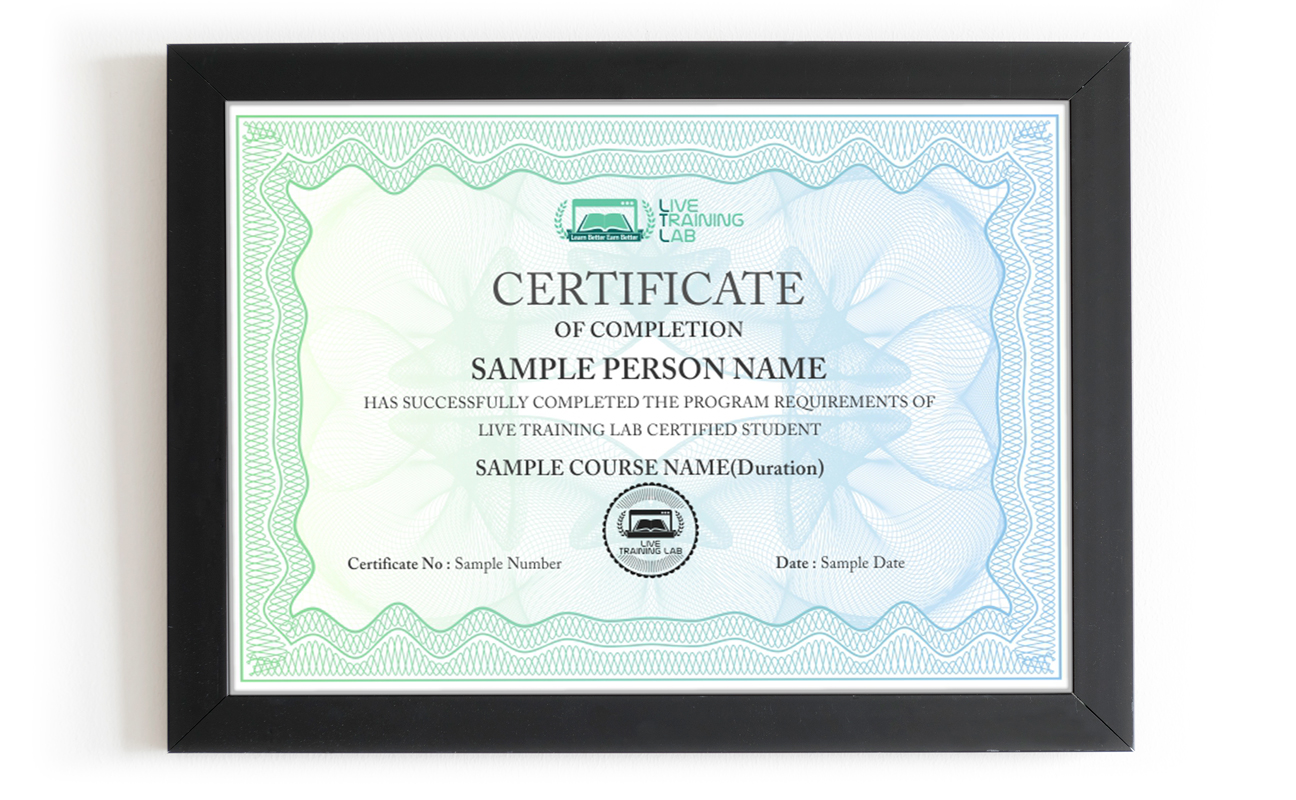
You can share your Certificate in the Certifications section of your social profile, on printed resumes, CVs, or other documents.
CURRICULUM
- Static vs. Dynamic Web Sites
- Dynamic Content from Databases
- Developing Dynamic Internet Applications
- Client-Side Scripting vs. Server-Side Scripting
- Overview of PHP Advantages and Capabilities
- Configuring php.ini
- PHP vs. ASP
- Conditional Constructs
- if, else and else if
- switch/case Statement
- The ? (Ternary) Operator
- Time stamps
- Introduction to Functions
- Declaring Functions
- Scope
- Passing Arguments to Functions
- Local and Global Scope
- Passing Arguments to Functions by Value and Reference
- Returning Values from a Function
- Using Include Files
- The Require Statement
- Recursion
- Dynamic Function Calls
- Predefined PHP Functions
- What are Arrays?
- Usage of Arrays in PHP
- Array Indexing
- Initializing Arrays
- Operating on Arrays
- Sorting Arrays
- One-Dimensional Arrays
- Multi-Dimensional Arrays
- Associative Arrays
- Array Functions
- Forms and Arrays in Web Applications
- Searching File Contents With Regular Expressions
- Changing and Editing File Contents
- Splitting and Joining Information Inside Files
- String Functions
- Regular Expression Functions
- Reading, Writing and Deleting Files
- Handling File Permissions
- File Locking
- Reading Directory Contents
- Creating and Deleting Directories
- MySQL as a Client/Server Solution
- Introduction to MySQL Capabilities as a Powerful RDBMS
- Installing and Configuring MySQL
- Connecting to MySQL
- PHP Functions Specific to MySQL
- Executing SQL Calls
- Using PHP MyAdmin to configure MySQL
- Error Logging
- Session Management and Maintaining State
- Web Application Architecture
- Using Environment Variables
- Changing Execution by Redirecting to Other URLs
- Embedding JavaScript within PHP
- Using the HTTP Protocols to Pass Data
- Showing Different Content to Different Browsers
- Getting IP Addresses from Visitors
- Basic Scripting and Looping Constructs
- Print Statement
- Code Blocks
- Primitive Data Types
- Defining Constants and Variables
- Looping Constructs
- Apache Configuration Files
- Configuring Apache for PHP
- WWW Sites within Apache
- Apache Virtual Hosts
- Website Properties
- Logical Operators
- Relational Operators
- Bitwise Operators
- Other Operators
- Configuring PHP For Database Support
- PHP’s Database APIs
- PHP’s SQL API
- MySQL vs. Access
- MySQL vs. SQL Server
- Database Drivers
- Database Driver Class Wrappers
- ODBC
- Simple SQL Queries via PHP
- Tracking Visitors with Session IDs
- Populating Forms
- Retrieving Data from Forms
- Required Characteristics of an E-Commerce Site
- Authentication and Authorization
- Data Validation
- Building a Custom Shopping Cart
- Persisting Shopping Cart Data Over Multiple Pages
- Criteria for Evaluating Third Party Shopping Cart Solutions
- Open Source vs. Commercial Shopping Cart Solutions
- Order Processing via the Web
- Implementing Order System Security using SSL
- Using Mail Servers (SMTP and Sendmail) for Client Communication
- Configuring E-mail Output Parameters
- Purpose of Cookies
- Cookie Myths
- Setting Cookies
- Retrieving Cookies
- Expiring Cookies
- Deleting Cookies
- Storing Arrays in Cookies
- Collecting Together Reference Material
- Final
- Presentation
Batches, Timings and the 4-Week Plan
The PHP course runs over 4 weeks and follows the curriculum above. Week one covers how dynamic sites work, configuring PHP and Apache, syntax, variables, operators, conditionals and loops. Week two moves to functions, scope, includes, recursion and arrays in all their forms. Week three is files, regular expressions, string handling, and MySQL: connecting, querying and administering with phpMyAdmin. Week four covers sessions and state, cookies, form handling, validation, authentication, a shopping cart, and the final project.
Batches run morning and evening so students and working people can both find a slot. Your timing is confirmed at enrolment, and the trainer stays reachable through the course.
Who This PHP Course Is For
Front-end learners who can build a page but cannot yet save anything from it. WordPress users who want to write their own functions instead of hunting for a plugin. Students and graduates aiming at a back-end or full-stack job. Freelancers who keep turning down work that needs a database. Small business owners maintaining their own site.
Some HTML and CSS helps, but no programming background is needed. Week one starts from the basics. If you already write PHP and want the MySQL, sessions and e-commerce side, mention it at enrolment and the early sessions will move faster.
Why Choose LiveTrainingLab for PHP
Plenty of people try to learn PHP from recorded videos and PDF files. It looks cheap and flexible, and then the folder sits untouched after the first white screen of death. Nobody reads your code, nobody explains the error, and there is no set day when the next lesson happens.
When we ask learners why the self-study route did not work for them, the answer is usually a version of the same thing.
Reading a PDF never built the skill. It turned into memorising syntax instead of actually writing code. With a recording there is nobody to ask when your query returns nothing, and no task that gets checked. A live class fixes both. You share your screen, your trainer reads the error with you, and it is sorted in the same session. That is how PHP actually sticks.
PHP is one of the friendlier languages to start with, especially if you already know some HTML. The parts that trip people up are database connections and sessions, and those are exactly where a live trainer saves you days of frustration.
- The LiveTrainingLab PHP course runs over 4 weeks of live classes, taking you from syntax and functions through to MySQL, sessions and a final project. You keep the material afterwards so you can keep building once the batch ends.
AI tools write code quickly and confidently, including code that is wrong. Someone still has to know what the application should do, spot the bug and fix it. That judgement is what the course builds, and it is the part worth paying a developer for.
Yes. Week one assumes you have never written a line of code. Some HTML and CSS makes the early sessions easier, and if you have none, tell your trainer at enrolment so the pace is set accordingly.
- Language stops a lot of capable people from getting far with programming. The logic is there, the English is not, and the class moves too quickly to follow. So our trainers teach the PHP course in English or Urdu, switching between the two mid-session when it helps someone follow. Batch timings are set when you enrol, and the course runs over 4 weeks.
Because at Live Training Lab, learning goes beyond theory. You get real projects, live mentoring, and job-ready skills that make you stand out in the job market and freelancing platforms.
Because at Live Training Lab, learning goes beyond theory. You get real projects, live mentoring, and job-ready skills that make you stand out in the job market and freelancing platforms.
We want solid PHP skills to stay within reach of students and working people, not priced like a corporate bootcamp. The fee stays low without shortening the live sessions or crowding the batch.
Every student gets the same attention from the trainer, whichever batch they sit in. Ask us about current fee options when you enquire, and we will tell you what the 4-week course costs before you commit to anything.
It helps a great deal, since PHP produces the HTML a browser displays. You do not need to be expert at it, and your trainer will fill the gaps as they come up. If you have never written any HTML, say so at enrolment.
A laptop or desktop, a steady internet connection and a headset. Classes run on Zoom, so the app or a browser is enough to join. Your trainer will help you install a local server and a code editor in the first session, so nothing needs to be set up in advance.
About Instructor

Zohaib Baig
Before engineering, I developed and implemented CI (Continuous Improvement) management systems in companies across America in various industries to include a military finance organization.
₨32,000.00₨16,000.00